“The West starts listening to the Russians.”
Steve Witkoff is pushing Kiev and the Europeans toward the settlement Moscow has long sought.
18 NOVEMBER—President Trump, at this writing, is in Shenzhen to attend a gathering of leaders from across the Asia–Pacific region. Shrug. The main event is his imminent summit with Presidents Putin and Xi on the sidelines of the A.P.E.C. session. There is every chance the Ukraine war will come up among these three leaders and every chance it will not. The Floutist doesn’t think this matters much one way or the other. The 47th president of the United States is incapable of diplomacy: Gesture and performance are all he can manage.
In the Ukraine case Trump has left all matters of substance to Steve Witkoff. And the New York property man—unlikely as this is—appears to be advancing the West toward an historical turn in its relations with Moscow. After 30–odd years of pointed neglect, an acknowledgment of Russia’s interests: The following essay considers the case.
—The Editors.
There is not much good to say about either Steve Witkoff or Jared Kushner, the New York landlords who proceed incompetently along as President Trump’s “special envoys.” While both seem to do well maximizing profit in the Manhattan real estate market, neither displays any fitness in matters to do with diplomacy or statecraft. I cannot tell what Kushner does other than speak for the Zionist state inside the Trump White House’s councils. As to Witkoff, he does seem to have one habit that now proves a virtue. Like the man for whom he fronts, he tends to agree with the last person who has spoken to him. This can be a good thing when the last person who has spoken to him has something useful to say.
So it now seems as negotiations resume in a multi-sided effort to reach an agreement that ends the Ukraine war and—the main thing—produces the enduring settlement between Russia and the West that Moscow has long sought.
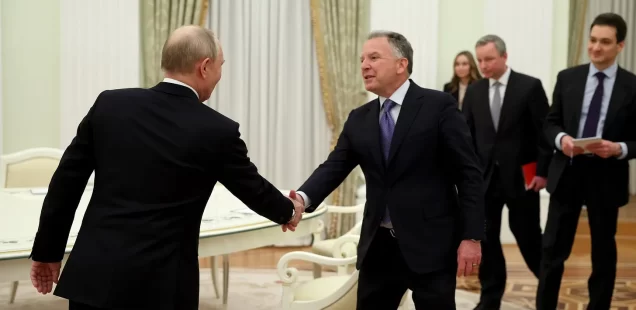
Last week Witkoff, with Kushner tagging along, convened the first talks since February that had Russia and Ukraine sitting across the same mahogany table. These were in Abu Dhabi and concerned a variety of topics: Russia’s security demands, a territorial settlement in eastern Ukraine, a ceasefire, some arrangement to include the Europeans in future negotiations—this last a prospect to which I will shortly return.
Nothing much came of the two days Americans, Russians, and Ukrainians spent in the capital of the United Arab Emirates—not according to Western media reports. A ceasefire is of course out of the question, as Moscow has made clear from the start; Kiev bangs on about this simply to elicit another Russin rejection—a tiresome exercise in propaganda. Neither the Russians nor the Ukrainians express much enthusiasm for a compromise on the territorial question, although The Telegraph, citing “U.S. officials,” reported just the opposite a few days prior to the Abu Dhabi talks. “Both sides have shown a little bit of flexibility privately, and so we’re going to start the discussion about what that can be,” the London daily reported from Washington 9 November.
A little flexibility. Expressed privately. According to a U.S. official. It is hard to say how one should read this kind of thing, but I do not see much in it other than an attempt to prime the pump, as Americans say. If you read the above quotation carefully, the Americans are talking about negotiating negotiations.
But I see a significant turn to the good in the days prior to and since Abu Dhabi. Subtly, other than forthrightly, Washington and the European capitals seem to accept at last that it is time to acknowledge what Moscow insists must be included in any agreement to end the Ukraine crisis it would be willing to sign. This looks to me like the sort of breakthrough that, we read, the just-concluded talks failed to achieve.
Moscow’s stipulations are what President Putin and Sergei Lavrov, the Russian president’s FM, call “the root causes” of the Ukraine war. The New York Times, in a piece published at the weekend, referred to these as “hard-line demands that stand little chance of gaining acceptance by Ukraine and its European allies.” Yes, yes, Russia’s interests have long been marked down as “non-starters,” that clumsy English-ism favored during the Obama and Biden years. But The Times, as so often, is once again behind the curve. “Hard-line demands” is yesterday’s rhetoric. As of Abu Dhabi, Moscow’s legitimate security interests are hard line only in the Western press, and negotiations that address them at last appear to be inevitable.
■
Depending on how one counts, Moscow has sought a comprehensive new security framework between Russia and the West since the start of the Ukraine war nearly five years ago, or since Putin personally tried to negotiate the two Minsk Protocols after the U.S.–cultivated coup in Kiev nearly 13 years ago, or since the Soviet Union’s demise 35 Christmases ago next month. But for details and context, Moscow has little that is new on the table now. It wants the North Atlantic Treaty Alliance to withdraw troops from what are now their easternmost positions, limits on the alliance’s missile deployments, a guarantee that Ukraine will not join N.A.T.O., other limits on the size of the Ukrainian military. These are chief among the Russians’ longstanding, long-expressed interests in a new East–West security architecture.
There is also the question of a territorial settlement between Moscow and Kiev. But in my judgement a fundamental renovation of Russia’s relations with the United States and Europe is a far higher priority for the Kremlin than what lines will eventually be drawn where on maps of what used to be eastern Ukraine. At this point the Russians are in the same position as the Iranians: As their confrontations with the Western powers have intensified, neither has any interest in returning to a status quo ante that leaves them isolated and in a state of constant insecurity.
There is no longer any denying—setting aside Western media reports—that the Ukrainians have no chance whatsoever of defeating the Russians regardless of the volume of support the Europeans waste on the corrupt regime in Kiev. While this accounts in part for the West’s new willingness gradually to accommodate Moscow, I see Witkoff’s hand in this turn. The Russians may not be the last people to have spoken to him at a given moment, but he plainly listens when they do. Witkoff wants hand his friend and employer “a deal,” and Moscow has made it plain there will be none unless it addresses the Russian Federation’s long-term interests. If this is what it takes to get Russian diplomats to the table, Witkoff has apparently concluded, this is what must be put in play: Such is my read of the New York landlord’s thinking, and by extension Trump’s.
I rest this conclusion in part on the shockingly realistic plan Witkoff made public a year ago next week, which came after extensive consultations with senior Russian officials. An East–West dialogue to resolve of “all security issues,” no further N.A.T.O. enlargement, Ukrainian neutrality, a “general amnesty”: These were prominent among the document’s 28 points. The second of these captures this endeavor’s underlying vision (a strange word when referring to Witkoff, but I will leave it): “A comprehensive and comprehensive [sic] non-aggression agreement will be concluded between Russia, Ukraine and Europe. All ambiguities of the last 30 years will be considered settled.”
The extent to which the plan attended to Moscow’s interests brought Witkoff in for a lot of criticism, and Kiev and the Europeans did their best to subvert it. I counted this acknowledgment of Moscow’s perspective among the document’s great virtues. Witkoff and the man for whom he acted understood then what the Europeans are only now coming to acknowledge: Russia has won the war, or is on the way to doing so, and any “deal” to be struck with Moscow must reflect this.
“When American-led talks to end the war in Ukraine resumed last week in Abu Dhabi,” The New York Times reported last Sunday, “the overriding question was whether Russia intended to give any ground after a nine-month lull in negotiations.”
Completely upside-down. Post–Abu Dhabi, the overriding question was and remains how long it will take for the Kiev regime and its European sponsors to accept that the cause is lost and proceed accordingly toward a settlement they have heretofore done everything in their power to prevent.
■
After refusing all contacts with Moscow for the past five years—diplomacy itself rendered inadmissible—the Europeans now want a seat at the table in what talks are to follow last week’s negotiations. “Europe will have a voice,” Volodymyr Zelensky declared grandly after Abu Dhabi. There is “a window of opportunity,” the Ukrainian dictator added, for peace by year’s end.
I am not waiting for it.
Jared Kushner appears to have precipitated this new enthusiasm. “We cannot conclude this deal without the Europeans being at the table,” he declared after separate meetings with President Putin and Zelensky. But Jared Kushner seems to have made a mess, it now transpires. At writing it is not clear the Europeans will be permitted any such place. The Times of London reported Monday that Moscow has so far rejected any thought of European participation.
And who can blame the Russians? The European Union has serially betrayed them, notably but not only when the Germans and French dishonestly negotiated the Minsk Protocols with no intention of honoring them, as they later admitted. More recently the Europeans have pretended to favor peace while assiduously prolonging the war and blaming the suffering and carnage on Moscow.
The E.U. has been in a dither as momentum toward a negotiated settlement has become apparent. Support for the Ukraine project among some members—Spain, Italy, Hungary—is much weakened. Norway and Britain are not E.U. members. The East Europeans worry Core Europe will betray them. “Under no circumstances will we allow new security rules for this part of the world to be established over our heads,” Donald Tusk, the Polish prime minister, said as the Abu Dhabi talks concluded. This is a familiar but foolish argument. While the traumas East Europeans suffered during the Soviet period are to be acknowledged, these are the last people, scarred psychologically as they are, to whom the E.U. should look for sound judgements on Russia.
At a summit in Dublin last Friday the E.U. voted to overcome its fractiousness by appointing no fewer than six officials—from France, Germany, Italy, Poland, Britain, and the E.U. political bureaucracy—to speak at future talks with Russia, the United States, and Ukraine in that European voice Zelensky mentioned. I do not see this working out, even allowing for a change of mind in Moscow. What would this voice sound like and say? As one of four delegations at the table, what would be its contribution as those objectionable peaceniks representing the Trump regime press toward a sensible settlement with the Russians? Will the E.U., in a dramatic volte-face, now work toward such a settlement? One would like to think so, but I do not see this working out, either.
I do not trust the perfidious Europeans any more than Moscow appears to do.
This will prove a telling moment for Europe, whether or not it assumes a place at the table when talks on Ukraine resume. One way or the other, what “Europe” means, what it has made of itself, and how its future is likely to turn out will become clear. I do not expect good to come of this, having hoped forlornly for many years that the Continent would make itself an independent pole of power with a voice others would want to hear.
There are times one can use events as mirrors to reflect realities not otherwise apparent, a practice I learned during my years as a correspondent. This is such an occasion. After all the years they refused diplomatic contacts with Moscow, what does the Europeans’ sudden desire to participate in a settlement of the Ukraine crisis indicate if not a bitter recognition that there is no defeating the Russians in war and no longer any gain in ignoring their interests?
■
President Trump is due to meet jointly tomorrow with Presidents Putin and Xi Jinping on the sidelines of the annual session of the Asia–Pacific Economic Cooperation, a not-very-consequential forum that has never figured out how to finish its name. This will be a first: These three have not previously summitted together.
Depending on what press one reads, Trump will or will not discuss the Iran crisis and will or will not raise the Ukraine war and progress toward a settlement. Among the more paranoic assessments of what will transpire in Shenzhen, the industrial city on the mainland’s southern coast, is a suggestion that the three leaders will determine Ukraine’s future, Yalta-like, without conferring with Ukraine. (Given the depth of the Zelensky regime’s corruption and irresponsibility, I see nothing wrong with such a thought, but let us leave this for another time.)
Nothing is yet clear. Trump is much-weakened since the Republicans’ disastrous showing in legislative elections earlier this month. Alastair Crooke suggested in a just-posted podcast that what we call the Deep State is now attempting to subvert the Trump regime altogether, just as it did his first term. How far this will go is also unclear, but disrupting Trump’s efforts to reconstruct relations with Moscow was the principal objective of that first endeavor to sink his ship.
All to be watched.
Trump made one remark just before the Abu Dhabi talks that merits brief consideration. In an interview with Ross Douthat, previously a New York Times columnist and now a correspondent at CBS News, Trump reflected on the prospects of an imminent settlement of the Ukraine crisis and said, “I think we’re going to have it done, and I think it’s going to happen and they’re going to end up with a little bit different shape, Ukraine.”
What gets done when is never certain when the Trumpster holds forth. But I take his strikingly specific mention of new territorial arrangements as another mirror—this one reflecting Steve Witkoff’s apparent progress toward a final settlement with the Russians that Ukraine and the Europeans will eventually have to accept.
■
Revised and expanded from its appearance, in German, in Global Bridge.
The Floutist publishes this piece without a paywall. We ask those who are not paid subscribers to consider becoming one: We can use the support of all those who see worth in the work. A subscription is $5/month or $50/year. Every dollar is appreciated and helps keep us going. You can also support us by sharing this article.
For those readers who are already subscribed, our usual and sincerest thanks.