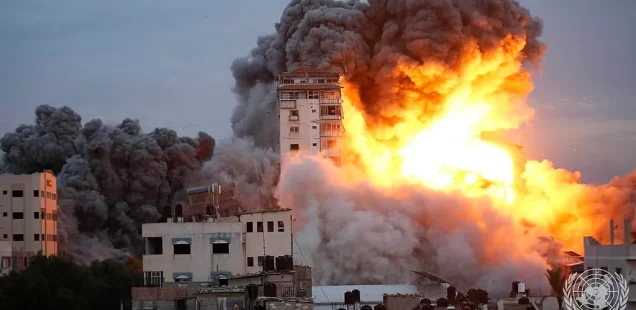
“When democracy fails: Reports from the West Bank.”
The admittance of Israel to the United Nations as a full member state in May 1949, and all that preceded and followed this event, reflects the catastrophic failure of Western democracy.
7 MAY—I’m dissatisfied, it’s time to state bluntly, with reporting events from the West Bank. It seems increasingly obvious that documenting and reporting Israel’s brutality is not enough. While reportage remains important for its contribution to historical documentation and as an expression of solidarity, it’s insufficient. The foundation of the problem and those who are responsible for it remain largely unaddressed and unacknowledged.
My Palestinian contacts are ever grateful to have their stories told and heard. And indeed, I will continue to share them. But reports in this vein keep Palestinians at a distance, cast as an objectified Other, always the victims of another’s violence while we—we Americans—are nowhere present. Except in our witnessing. But what is it we are witness to? Our own failures?
Accounts of Jewish Israeli depravity have taken on a perverse and dangerous quality of monotony. The stories have become predictable and almost formulaic. How many times can you read about destroyed olive groves, demolished homes, stolen land, the arrest and mass incarceration of men, women, and children, and settler pogroms and rampages in which Palestinians are killed and wounded? People quickly become numb to the violence in all of its manifestations, from mundane cruelties to unspeakable sadism. Numb and convinced there is little to nothing they can do.
And of course this presumption of powerlessness is among the intended consequences of Zionist impunity.
But something is missing when the focus remains on Israel. We—you and I, we in the West—are removed from the picture altogether such that we become invisible when, in fact, we are everywhere present in events as they unfold in Palestine and throughout West Asia. The grotesque slaughter and destruction carried out by the Israel-U.S. empire in the West Bank—and in Gaza, Lebanon, Syria, and Iran—is a direct consequence and expression of the failure of American democracy at home—the collapse of the American republic and the democratic ideals upon which it was ostensibly founded.
And this is where ordinary Americans fit into the larger picture of what is happening in the West Bank, and of course elsewhere. The situation in Palestine has always been a call to Americans—a call to wake up and save, not Palestine, but first of all ourselves.
It is this larger context that I begin to address in a lecture I gave on 10 April in Sirnach, Switzerland. What follows is the talk in its entirety, with minor editing.
—C.M.
I’m going to talk about the West Bank where, since the assault on Iran began, every roadblock and checkpoint has been closed—nearly 900 of them at last count. Schools are closed and classes are online. Villages that lack grocery stores and medical clinics are now cut off from both. Palestinians are forced to use primitive dirt roads where there’s always the danger of ambush by settlers.
Settlers rampage daily through villages, beating and killing people with impunity and with support from the Israeli military. The Knesset just passed a law that “imposes the death penalty for the deliberate killing of a person with the intention of ‘negating the existence of the State of Israel.’” This according to Human Rights Watch.
How did it come to this? I want to address this question as we consider the West Bank. The ethnic cleansing of the West Bank, the genocide in Gaza, which continues to this day, are happening because democracy in my country, the United States, has failed. We need to make this connection: between events in the West Bank and Gaza and the collapse of our democratic ideals.
The admittance of Israel to the United Nations as a full member state in May 1949, and all that preceded and followed from that, the betrayals of Palestine, the barbarities committed against the Palestinian people, the current assaults on Iran, Lebanon, and also Syria by the U.S. and Israel—all of this is evidence of the catastrophic failure of western democracy and Western democracies, foremost the United States.
There has been no public debate in America about any of this. No American, no ordinary citizen, was ever consulted; our consent was neither sought nor ever given. Our consent is irrelevant. Congress was coopted by the Israel lobby decades ago. Zionist billionaires purchased the executive branch. Sexual blackmail ensures compliance with Israel’s diktats. There’s a straight line from the Zionist lobbies to the corruption of the American Congress to what I’m going to tell you about the West Bank.
The failure of democracy in the United States runs deep.
The authority to declare war resides solely with the U.S. Congress, but Trump didn’t consult Congress before bombing Iran. He didn’t bother to make a case for war with Iran to the American people. The executive and legislative branches of my government—the president and congress—are in violation of the constitution. The U.S. military, in obeying Trump’s orders, is in violation of the constitution. And this has been so for a very long time. America hasn’t actually declared a war since December 1941. The United States no longer acts, not at home and not abroad, according to law.
This failure of which I speak is everywhere apparent: in the corruption of our institutions of governance including the judiciary, the loss of civil liberties, not least in the corruption of the media, to name but a few examples.
In sum: The United States is in a constitutional crisis. My country is in a process of constitutional collapse that began well before Trump’s second presidency.
And this explains America’s behavior abroad including what is happening in Palestine.
While the failure of democracy is seen most clearly at the institutional level it happens within the individual as well. I’m talking about a pernicious psychological state that I see in my fellow citizens. I see it because I recognize it, if perhaps more faintly, within myself. And here I’m describing and condensing complex social and psychological processes.
Consider distraction. Instrumentalized distraction. Distraction as a tool of social control. Everything now in the United States is a form of entertainment: food, exercise, spirituality, news—you name it.
“My Husband Can’t Get a Job. Should I Divorce Him?” That was a headline on an opinion piece in the New York Tims on Monday, 6 April, next to an article titled “A Harrowing Race Against Time to Find a Downed Airman in Iran.” This too is entertainment. And it’s all smoke and mirrors. Do you know this English term, smoke and mirrors? It refers to the tricks of a magician meant to obscure what he is actually doing.
The two articles I just mentioned are not value neutral. They’re subliminally pernicious. When you’re incessantly encouraged not notice or think critically about what your government is doing at home or elsewhere, you lose all inclination to do so. Distraction is a form of pacification.
Perhaps most damagingly, the distracted person becomes severed from his own intelligence, severed from his connection to others, severed from the inevitable solidarity that arises in connection with others. Distraction induces indifference. Not only do people become indifferent to the suffering in Gaza or Iran or West Virginia, for example, they become indifferent to never having been consulted about government policy and actions in the first place. Most Americans don’t even notice they haven’t been asked for their consent.
All of this encourages a willful self-sabotage. Distraction is easy. It feels good. People learn not to want the responsibilities of freedom, the responsibility that democracy demands of its citizens.
And of course distraction is compelling precisely because we all know—we Americans—that things are terribly wrong. A majority of Americans have come to believe that there’s nothing we can do to bring about effective change. This in turn leads to an acquired sense of helplessness, to hopelessness, and ultimately despair.
I’m calling this manufactured despair because it’s a direct consequence of the institutional failures of democracy. Feelings of helplessness, hopeless, and despair in turn result in a self-destructive passivity—another form of self-sabotage. But this self-sabotage is the consequence of the intentional sabotage of democracy by those in power. Despair is rampant in the United States. We have high rates of suicide and drug overdoses, which are referred to as “deaths of despair.”
And all of this—all of what I’ve just described—is directly connected to what’s happening in the West Bank.
■
When we met in August for Mut zur Ethik (an annual conference held in Sirnach, the name of which means “the courage to take a moral stand”), I gave a talk about the ethnic cleansing of Deir Alla. This was a bedouin community connected to the nearby village of Kisan through family relationships and shared land. When Deir Alla was destroyed Kisan became the next target of settler violence.
I will focus now on Kisan because it tells the story of what’s happening elsewhere in the rural areas of the West Bank.
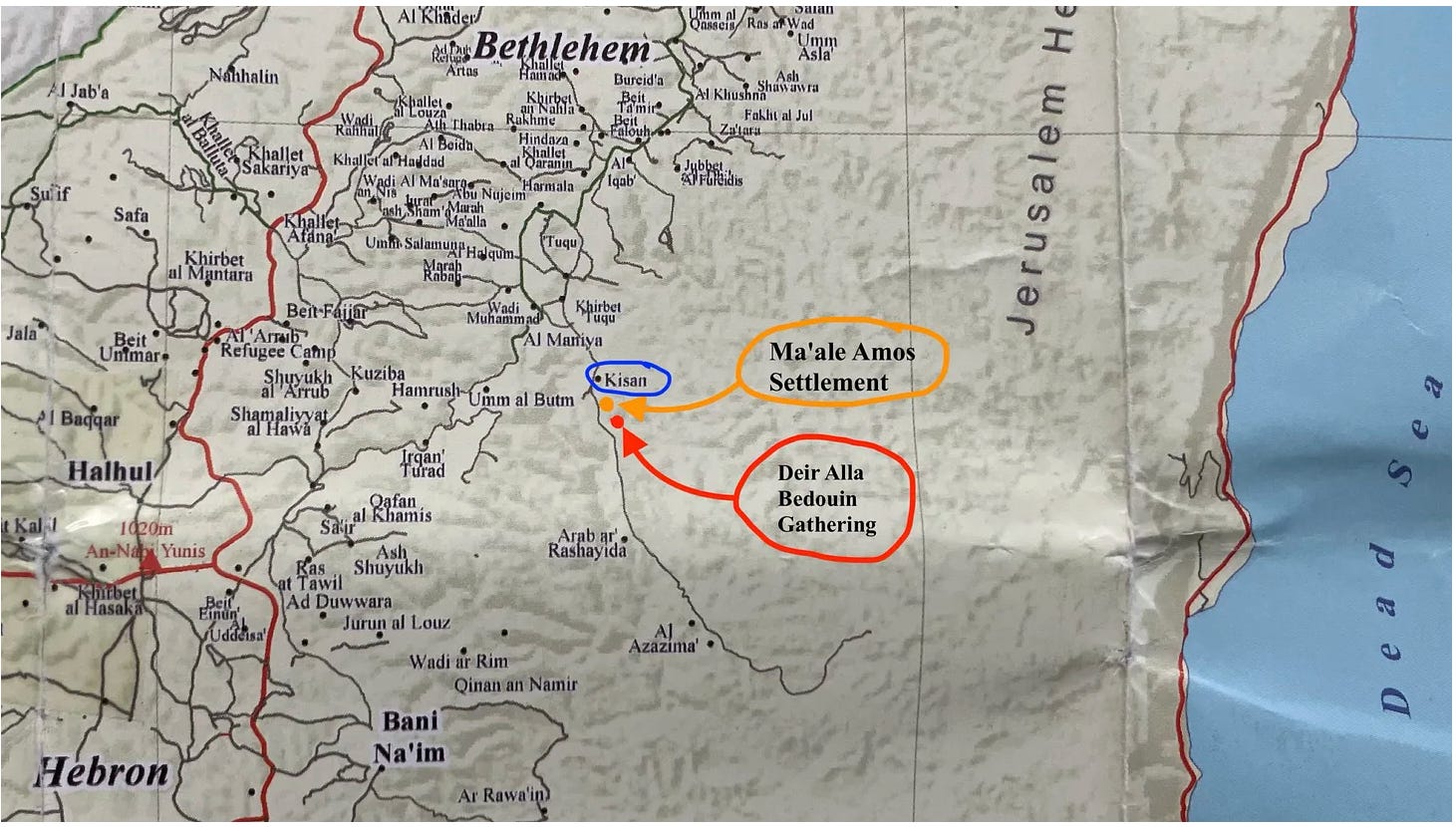
Kisan is located roughly 11 kilometers south of Bethlehem.
All of the historic land belonging to the village, land used for farming and grazing, has been seized. People in Kisa have had to sell many of their sheep to order to buy fodder for their remaining animals and to support their families financially. This includes the families from Deir Alla who are still living in overcrowded conditions with family members in Kisan because they have nowhere else to go.
To give you an idea of the harassment Kisan residents face every single day I’ll show you a few photographs. These are from before 28 February when the U.S. and Israel launched their war of aggression against Iran. Everything is now much worse. All of my information comes in the form of WhatsApp texts from Adnan al–Abayyat, who lives in Kisan and has been documenting settler violence for many years.
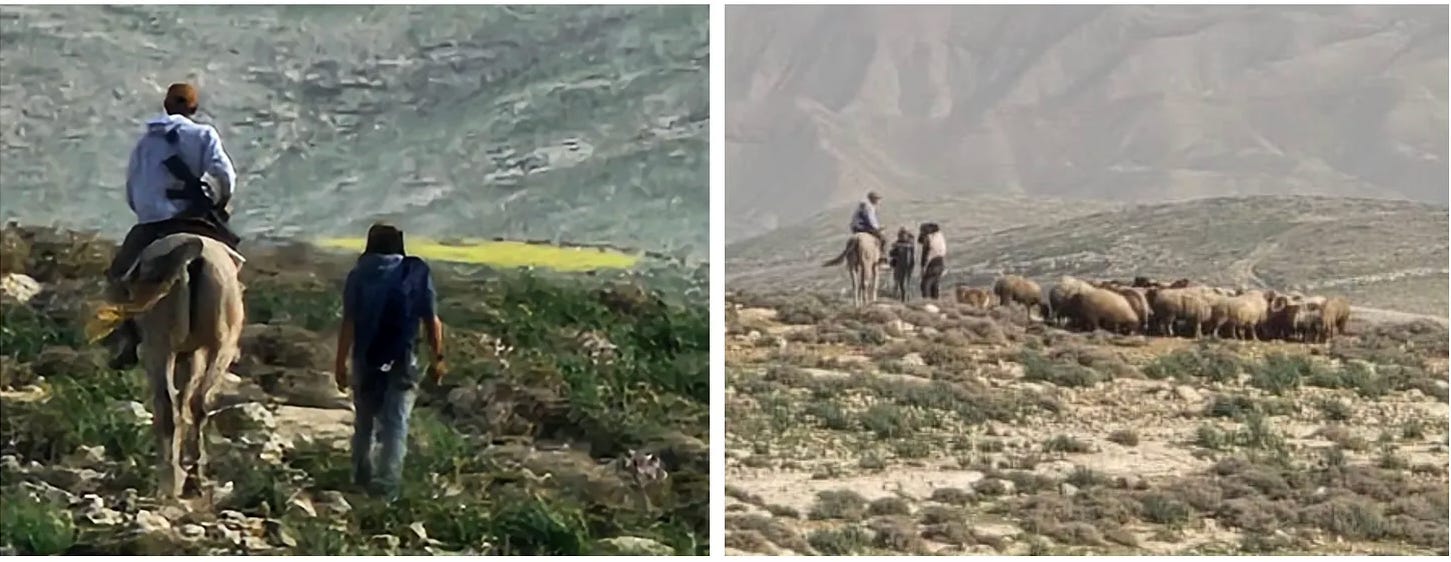
These photos (above) are from 13 February. They were accompanied by the following text from Adnan:
This afternoon, settler attacks against the residents of Kisan village continued. Armed settlers chased villagers away, preventing them from grazing their livestock on lands adjacent to the village and bringing settler shepherds to the area.
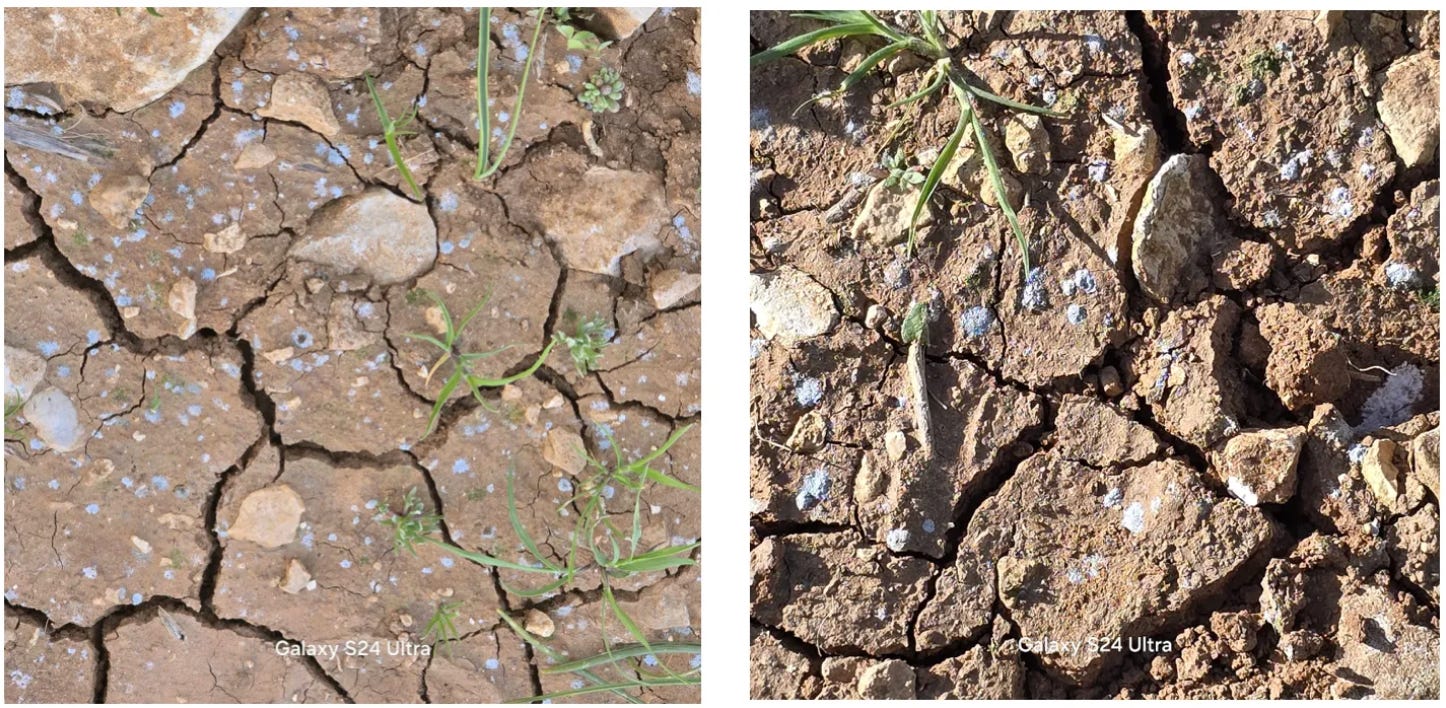
These photos (above) arrived also on 13 February. They show evidence of chemicals sprayed near one of the homes at the edge of the village. The chemical was most likely the herbicide glyphosate, which is frequently mixed with a blue dye so it’s application is visible. I was told by a contact who monitors human rights abuses that chemicals are being sprayed elsewhere in the West Bank.
During this same period of time the Israeli army sprayed glyphosate on agricultural land in southern Lebanon and in Syria at levels 20 and 30 times the recommended concentration. This was documented by the U.N., and reported fairly extensively, including in Haaretz but not in the U.S.
The spraying of herbicides on agricultural land is a war crime.
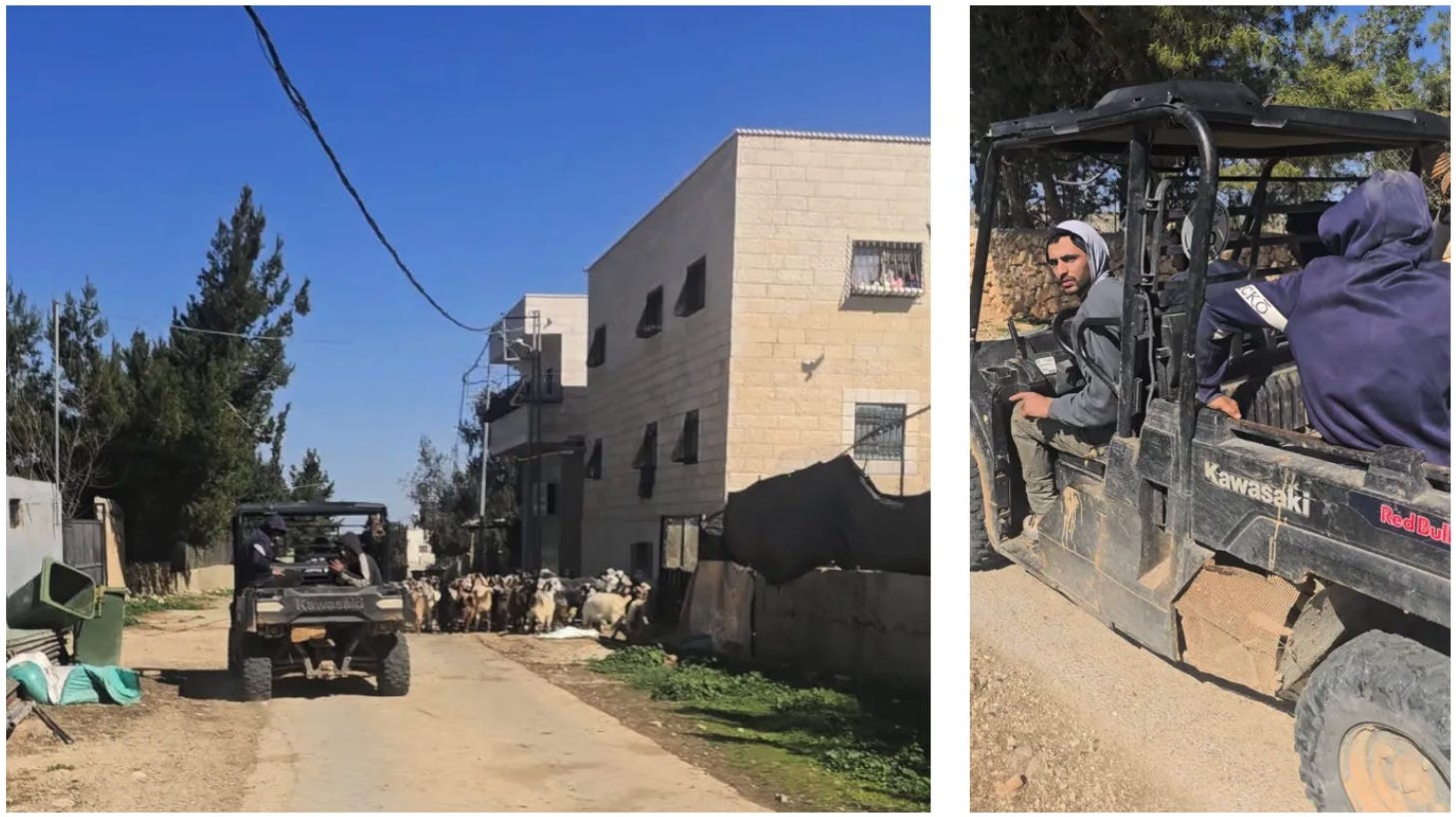
Here (above) is a picture of settlers using an all-terrain vehicle to chase sheep in Kisan. These animals are already stressed from malnutrition because they can’t be grazed. This is from 20 February.
Kisan is one of many small villages that doesn’t have a grocery store or a medical clinic. Since the war on Iran began, it’s been entirely cut off from direct access to the nearest villages that have both. A drive that used to take 20 minutes now takes close to an hour on dangerous dirt roads that are subject to settler attack.
Kisan is under a state of siege. The entire perimeter of the village is subject to armed attack. Settlers roam the village at will as a form of harassment. They, the settlers, bring their sheep right up next to the village and graze their animals in olive groves allowing the sheep to damage the trees (see video below). Meanwhile, the army won’t let Kisan shepherds go beyond 40 meters outside of the village.
Visit original article to view video.
■
On 14 March settlers attacked village shepherds and shot two men: One was hit in the thigh, the other in a foot. In the same attack, a woman had several fingers broken and two other men were beaten. One of these men had his arm broken and that man, with the broken arm, was arrested. In the end, sixty sheep were stolen.
In the following video settlers are seen rounding up the sheep. As Palestinians attempt to stop them you hear two gun shots. The second video shows settlers driving the stolen sheep away in one large flock. A Palestinian woman can be seen running after them in the lower right quadrant of the video. The chaos and panic are apparent.
Visit original article to view video.
Visit original article to view video.
■
The army raided Kisan on 26 March and entered numerous homes including Adnan’s. The soldiers had a message on their phones in Arabic which they played to people. Here’s Adnan’s text from that day:
The Israeli army raided several homes in the village, including mine. They told us not to gather, confront, or shout during any settler attacks. Instead, we are supposed to lock ourselves inside our homes. They recorded a message in Arabic on a soldier’s phone, essentially telling us to submit to the settlers and accept a new reality: The settlers have free rein to do as they please.
Let me be clear: Palestinians aren’t safe locked inside their homes. Settlers routinely throw molotov cocktails into homes. This happened in the bedouin community of Deir Alla this past July. In 2015, settlers burned a family alive inside their home. The only survivor, a boy of four, was badly burned over 60% of his body.
■
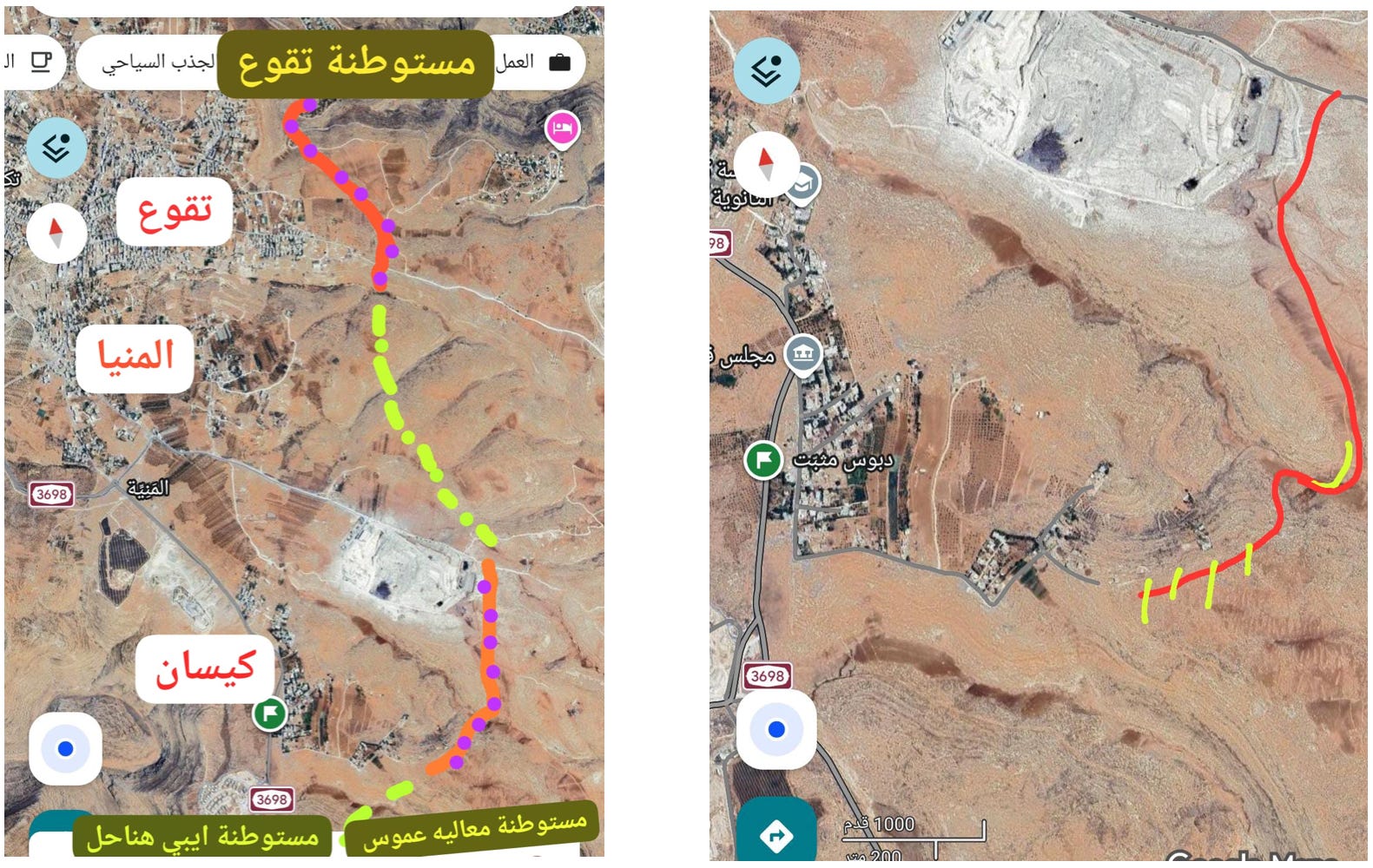
Settlers are now building a new road that will pass along the east side of Kisan, next to numerous homes which will likely be demolished. When finished, it will complete a road belt that will encircle Kisan and its two closest villages. The road will connect all of the settlements and outposts in the area and isolate the villages in a small encircled enclave. Adnan describes this as a “new reality to create Palestinian cantons isolated from each other and besieged in a way that prevents any expansion of Palestinian villages.” In short, the villagers have nowhere to go. As the population increases in the villages they won’t be allowed to expand.
In the first map below you see the three villages (left, top to bottom) of Taqoa, al–Miniya, and Kisan (red Arabic script). The lines on the right show where the road is going, connecting the illegal settlement of Taqoa (at the top in yellow script—the settlement taking its name from the nearby Palestinian village) with two other settlements below Kisan (script also in yellow). The photo at the right shows the road swinging near homes located at the edge of Kisan—the homes vulnerable to demolition. These maps are a testament to Adnan’s unflagging documentation of settler violence and expansion as his village is threatened.
■
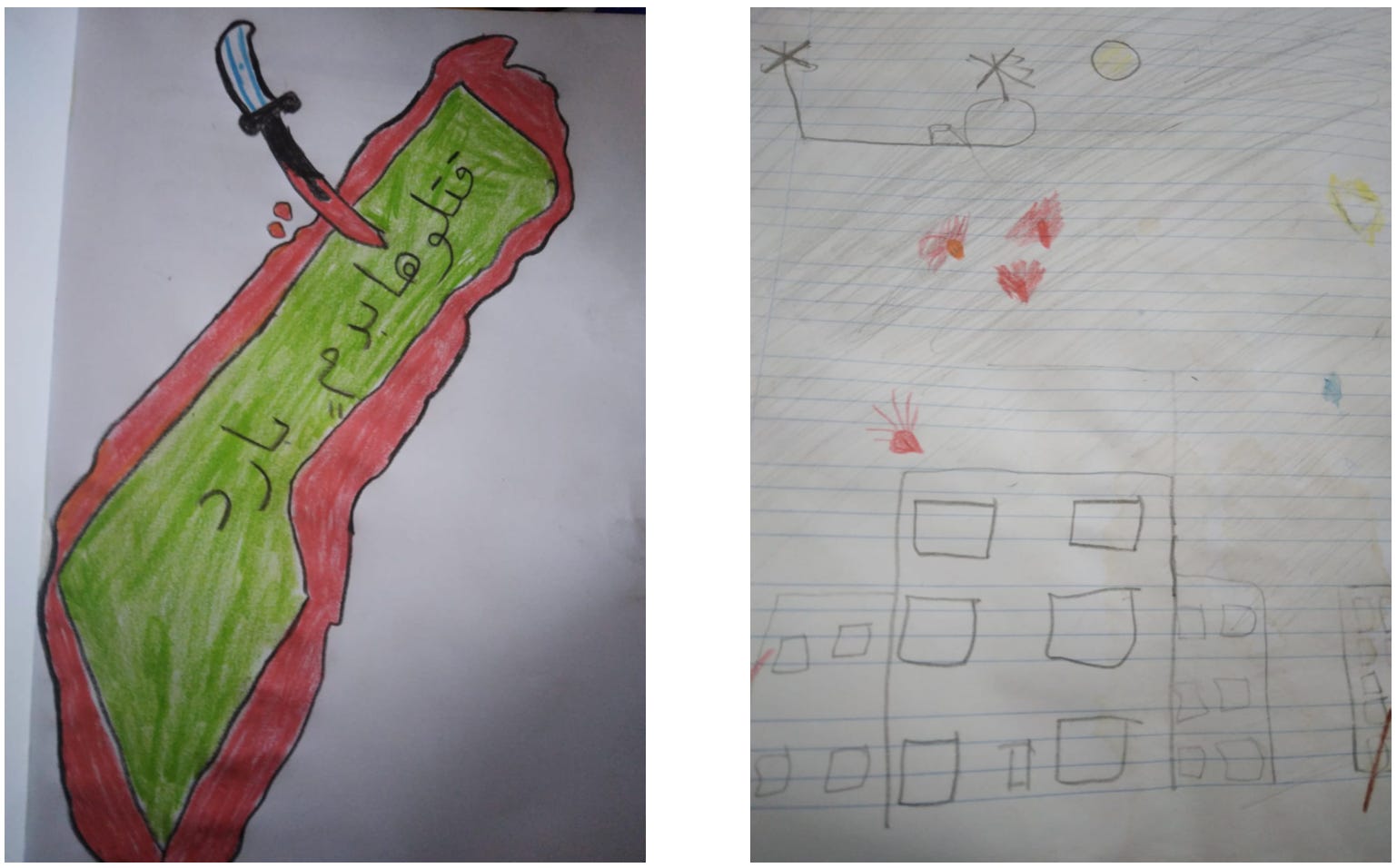
I texted Adnan’s wife to find out how the children of Kisan are doing. She sent pictures of children’s artwork along with her reply.
When the war on Iran began, the Palestinian Authority closed all of the schools and universities. All classes are being held on line. But Kisan, like other remote villages, doesn’t have internet. Only homes that have wireless internet SIM cards have access to the internet. And the signal is weak. Each home has 4 to 10 children in it and even with internet access families don’t have enough computers and other devices for them to use. These are poor families and most children are losing their education.
Because of the constant threat from settlers, and danger from Iranian missile fragments that have already killed people in the West Bank, the children spend most of their time indoors. They don’t meet with their friends. They rarely play outside. Children’s activities at the library have been reduced out of concern for their safety.
The drawing on the left (below) shows a map of all of historic Palestine—stabbed by a knife and bleeding. The Arabic reads: “They killed her in cold blood.” In the drawing on the right bombs are dropped on residential buildings.
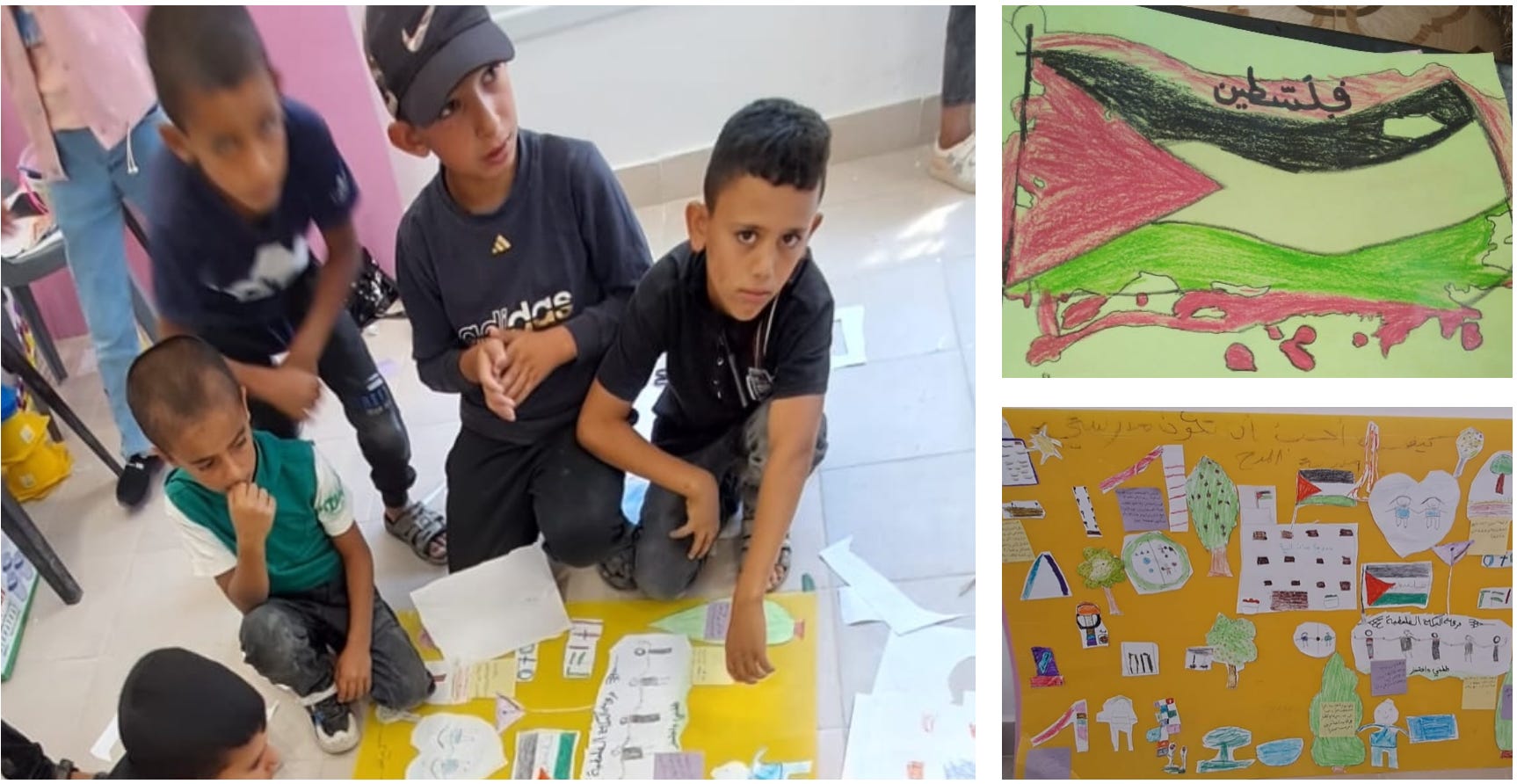
Students met at the library in February during Ramadan and created a cutout mural depicting their school and all of the things they miss since its closure (left, bottom left). The photo at the top right depicts a torn and bleed Palestinian flag.
■
Had democracy in my country not failed by slow degrees over a long period of time, life in Palestine would be very different today. Of this I am certain. Had our media in America not lost its independence, had it reported on events and abuses of power with objectivity and honesty and attention to history, almost certainly my talk today would have been very different. At this point we might wonder if the corruption of media has not indeed been the greatest failure of American democracy. The failure that enabled all others.
But if one must occasionally despair, as is only human, let us take a lesson from Palestinians. And here I quote my friend Sadeel texting me about despair in Palestine:
Of course we feel despair. But the way we deal with it is different, and most of the time we don’t have time to express it. We barely have time to feel it. But we do feel despair. But we have to let our emotions be the fuel for change instead of sitting and whining over our occupied land.
Palestinians feel despair but it’s a fuel for their resistance and not, as too often in America, an excuse for indifference and passivity. There is a real lesson here for us.
I’ll end now with the words of another Palestinian friend, Raya, who talks about hope. Raya was one of my partners on the kindergarten playground in al–Mughayyir. I’m happy to report the playground was completed in early February (as reported here). The children enjoyed it for two weeks and then the school was closed when the war began.
Here is Raya, from a text she sent that was previously published on West Bank Alerts:
Palestinians believe that the colonial reality imposed on them cannot be accepted or endured, it must be confronted. The presence of hope does not mean adapting to this reality; it means rejecting it. Hope here is not an emotional feeling, but a conscious stance and an act of resistance.
To have hope is to refuse the normalization of this reality. And in order to confront it, hope must remain, because without hope there is no life and no steadfastness. Hope affirms our inner existence, prevents us from breaking, and gives us the strength to continue.
Hope grows from the act of rejecting this reality. Its absence, on the other hand, implies acceptance and that is a tragedy. All our steadfastness is built on hope, and all our continuation depends on it. That is why hope must remain alive, no matter how harsh the reality is.
At the same time, the daily hardships people live under—occupation, poverty, loss, repression, and closed horizons—understandably shape their emotional state. It is true that you may see people who appear exhausted, discouraged, or even hopeless on the surface. This does not mean that hope is absent; it means that hope exists under pressure.
As Mahmoud Darwish wrote, ‘We love life if we find a way to it.’ This love of life is not denial of pain, it is resistance to it. People may look tired, but they continue to live, to love, to raise their children, to plant their land, and to remain. And this, in itself, is hope.
Published previously at Winter wheat and West Bank Alerts.
Everything I write is freely available. If you appreciate what you read, please consider supporting my work. You can become a paid subscriber by clicking on the button below. You can “buy me a coffee.” You can send a one-time, monthly, or yearly donation via PayPal. Or you can support me on Patreon. You can also share this report. Thank you.