“‘Russia is running out of steam.’ Really?”
The Ukraine war as seen from Kursk.
Summer readings.
The New York Times just ran a pair of especially preposterous pieces concerning the state of the war the West wages, via Ukraine, against the Russian Federation. It seems John Ratcliffe, the C.I.A.’s director, paid a not-very-secret secret visit to his counterpart in Moscow last week, and we are to believe he flew to the Russian capital—out of compassion, was it?—to advise the pitiably ignorant Russian leadership that it is in desperate military and economic circumstances and it would be best if it negotiated an end to the war:
As per:
John Ratcliffe, the C.I.A. director, made a secretive visit to Moscow this week to privately share his bleak assessment of the state of the Russian war against Ukraine, and to urge the Russians to cut a deal before their military and economic situation gets worse, current and former officials said….
C.I.A. analysts have long questioned whether Mr. Putin’s advisers have given him honest assessments of the war’s trajectory and toll.
As will be obvious to anyone who considers this ridiculous proposition, Ratcliffe’s intent was in all likelihood upside-down from these reports: The desperation lies with Ukraine and its sponsors, and Ratcliffe was in Moscow to see what it would take to get Russia back to the negotiating table now that it has begun to respond decisively to Europe’s and Ukraine’s incessant provocations.
It is remarkable to discover, as one does not infrequently, just how stupid The Times estimates its readers to be.
The Floutist is especially pleased, amid this sort of propaganda, to publish the latest reports of Guy Mettan, our distinguished Geneva correspondent, who recently returned from another of his journeys. This one was to Kursk, the Russian province that borders Ukraine, which endured a Ukrainian incursion two Augusts ago.
Guy, as always, takes an eye-of-the-camera approach to his reportage, writing strictly what he sees. This is, apart from his excellent powers of observation, one of the qualities that makes Guy’s work invaluable. Among much else, I am impressed to detect in his report the active sense of solidarity and common purpose that, I assume, remains from Russia’s socialist decades.
This is the first of The Floutist’s Summer Readings, and we can do no better than begin these with Guy Mettan’s exceptional pieces. A second report will follow. This first includes extracts from an exchange with Alexander Khinstein, governor of the Kursk Oblast. “What Ukrainian militants did in our region,” he tells Metttan and his colleagues, “constitutes pure 21st–century Nazism.”
—P. L.
■
Guy Mettan.
KURSK—For the past four months, we have been told over and over again that Russia is on its last legs. Putin, we are assured, is panicking, hiding in his bunker, while the Russian people are supposedly on the verge of rebellion, angry at having to queue at petrol stations running dry because of Ukrainian strikes on oil refineries. This narrative, tirelessly echoed by virtually every medium in the West, appears to have become an indisputable truth.
Yet, when confronted with reality, this proves to be just as false as the many narratives that have preceded it since the beginning of Russia’s military offensive in 2022. In Moscow, hotels are packed with Indian, Saudi, and Turkish tourists. And in the provinces, even in areas close to the front line, such as the Kursk region, life goes on almost as if nothing of any consequence has happened.
In early July, a conference organised by Southwest State University here to mark the 83rd anniversary of the famous tank battle of July 1943 in Kursk gave me the opportunity to travel across the oblast shaken by the Ukrainian invasion of August 2024 and to observe the state of mind of its inhabitants fifteen months after the Russian military forced Ukrainians back across the border and the fighting ended. I apply no filters in this report, no moral judgements: I write simply what I saw and heard. It is for readers to form their own opinions, as with any reportage worthy of the name.
Late in the afternoon, the square in front of the opera house in the city of Kursk is crowded. Groups of young people are listening to music, and passers-by pay little attention to the occasional sirens or the anti-drone alerts appearing on their smartphones. The streets are clogged with traffic, shopping centres are packed, and grocery stores are overflowing with fresh fruit and vegetables.
In the outlying districts, the situation is somewhat more tense. Drone attacks occur daily. The power station in Lgov, along the Seym River 80 kilometres west of here, is targeted almost every night, and some neighbourhoods regularly experience power cuts. Most households are equipped with backup generators.
The oblast’s fields are being cultivated and, here and there, roads are being repaired. Contrary to appearances, there is no shortage of diesel or gasoline for vehicles designed to run on these fuels. Some petrol stations, however, are besieged by long queues, except for those taking advantage of the shortages to double their prices.
In Lgov, which is a small village in the Rilsk area, Anatoly, an old farmer, shows us the damage caused by a drone attack on 22 May. For reasons he still does not understand, three drones targeted his home in less than ten minutes during the night. The first missed its target and left a large crater in the meadow. The second destroyed his brother’s house—fortunately, his brother was at work at the nuclear power plant in Kurchatov, some forty kilometres away.
The third obliterated his garage, car, and farming equipment, damaged his barn and house, and injured his wife. He shows us the wreckage of his car and the remains of the drone. He has only recently returned home. A team of around ten volunteers from all over Russia has already repaired the roof and façade and is completing the reconstruction of the stable. Under the amused gaze of a stork, other volunteers—mostly retirees—are busy restoring the neighbouring cultural centre, whose windows were blown out by the explosions and shrapnel.
These volunteer movements are far from isolated. In Kursk, Svetlana and the organisers of the “House of Good Deals,” an aid-distribution centre for those forced from their homes during the incursion, tell us how they spontaneously assembled aid for the thousands of refugees who fled the southern districts of the region during the Ukrainian invasion. Through appeals on social media, they managed to collect donations from across Russia within a matter of days and provide food, clothing, and shelter to thousands of bewildered people by transforming Belinskaya Street into an open-air relief centre.
They did so entirely on their own initiative, without any state intervention. One of the volunteers laughingly hands me a copy of the front page of the Financial Times, showing her surrounded by tired and disoriented people under the caption: “Refugee abandoned by Putin!” She is not the slightest offended.
Near another village further on, an industrial farm suffered irreparable damage from a salvo of American-made HIMARS missiles. The silos have been ripped open, machinery destroyed, and the roofs of the sheds have collapsed. The last major attack took place in March. Only a few days ago, a strike with a first-person-view drone, an F.P.V., tore a hole in the roof of a large residential building, fortunately causing no casualties. Our visit is protected by an anti-drone jamming system deployed on the ground and, in principle, we are perfectly safe. On the ground floor of one building in the village, an elderly woman can be seen calmly going about her business in the kitchen, utterly unfazed.
Such is life in the regions close to the front.
■
What is the mood among the population? Are people rebelling against Putin? Are they weary of a war that has now lasted more than four years?
After several days of visits and meetings in the Kursk region, I am convinced that these questions preoccupy European visitors far more than they do local inhabitants, who have learned to live with war and who, above all, have the feeling of having relived in 2024, when the Ukrainians invaded, what their grandparents endured in the summer of 1943, when Nazi Germany attempted, on this very ground, to break Soviet resistance and crush the Red Army. It was the largest battle of the Second World War, and perhaps in human history, bringing together six million combatants, 6,000 tanks, 4,000 aircraft, and 40,000 artillery pieces—and causing 1.1 million casualties.
Ukrainian losses during the 2024 invasion are estimated at around 40,000 dead and missing, approximately 1,000 armoured vehicles lost on each side, some 300 Russian civilians killed, and 130,000 refugees displaced. But it is not the scale of the forces engaged or the losses sustained that prompt recollections of the World War II Battle of Kursk. No, they arise because of the nature and symbolism of the fighting. From the Russian perspective, the rhetoric employed by President Zelensky, the timing and location of the attack (6 August 2024 versus 5 July 1943, with Kursk as the focal point in both cases), and the forces involved—a coalition of Western countries and mercenaries confronting a besieged Russia—amount to a smaller-scale remake of the Nazi offensive of 1943, which included not only the Wehrmacht but also Italian, Romanian, Hungarian, and Croatian army corps.
I was also told that, during the Ukrainian withdrawal last year, Ukrainian troops set fire to a church in whose foundations the remains of 300 Hungarian soldiers were discovered a few months ago. They had been executed by the SS in 1943 after laying down their arms instead of fighting the Red Army. For the inhabitants of Kursk, situated at the crossroads of successive invasions, history often seems to stutter.
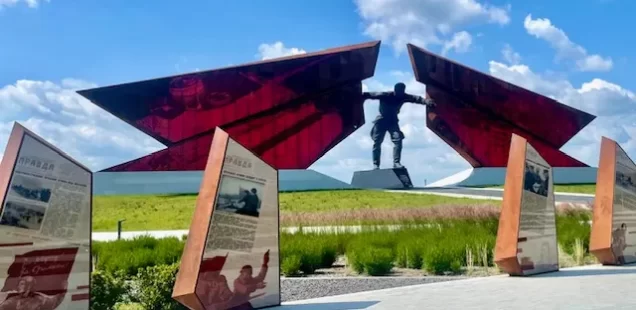
At Ponyri, the epicentre of the German offensive some forty kilometres north of Kursk, the new memorial complex commemorating the great battle, inaugurated in 2023, depicts a Soviet soldier pushing apart two German tanks with his bare hands. Visible from miles away, the monumental memorial lists the Heroes of the Soviet Union who fell in battle—and awaits, perhaps, those of 2024.
A new annex has already been built displaying the wreckage of Stryker, Marder, Humvee, and MaxxPro vehicles destroyed during the Ukrainian invasion, together with an impressive collection of Western weapons recovered from the battlefield: drones, machine guns, shells, grenades, ammunition, and missile launchers manufactured in Italy, Sweden, the United States, France, South Africa, and Turkey.
This arsenal illustrates the scale of Western military assistance to Ukraine and the military graveyard that this war has become on both sides of the front. For Russians, there is no doubt that they are now fighting the collective West in a total and merciless war, with Ukraine reduced to little more than a proxy in this deadly confrontation. And this perception exists without any need for “Putin’s propaganda” to embellish it.
This is perhaps the principal lesson I take away from my stay: Rightly or wrongly, Russians feel that they are once again threatened with invasion and destruction and that the offensive of the summer of 2024 was merely a local prelude to the current attacks against their civilian population and infrastructure. Every day, schools and buses are targeted and civilians are killed. Under such circumstances, and as long as this threat persists, they believe that surrender or concessions to the enemy are simply out of the question. With Putin or without him—that is not the issue.
■
Alexander Khinstein has been governor of the Kursk Oblast since 21 September 2025. He was tasked with rebuilding the region after the Ukrainian occupation of 2024–2025. What follows are extracts from his responses to our questions.
How did the population experience the invasion by the Ukrainian Armed Forces in 2024?
It is important to understand that the Kursk region is much more than a border territory. A thousand years ago, Kursk was founded as Russia’s principal southern outpost and has fulfilled this defensive mission throughout the centuries. The same is true today.
In the summer of 2024, the region faced an unprecedented challenge: the invasion by the Ukrainian Armed Forces. Nothing comparable had occurred in our country since the Second World War. It was an attempt to terrorise civilians, take hostages, and destroy infrastructure. Tens of thousands of residents were forced to flee their homes in an emergency, taking with them only what they could carry. People lost their homes and the fruits of lifetimes’ work, while some lost what was most precious of all—their loved ones.
What did this period reveal? It revealed—I say this without hesitation—the heroic character of the people who live on this land. The entire country mobilised in support of the Kursk region, and local residents demonstrated unprecedented solidarity by donating supplies, giving blood, providing food and accommodation, and supplying everything that was needed.
Today, following the complete liberation of our territory, life has largely returned to normal, although we continue to live and work under difficult conditions, facing constant threats and daily provocations from the enemy.
The consequences are severe: destroyed homes and damaged infrastructure. Yet the entire country stands with us and provides considerable support. That is why we are confident that we will overcome these difficulties.
What are your priorities as governor, particularly regarding security?
Security has always been—and remains—our absolute priority. Unfortunately, under present circumstances the threat is real and permanent. Enemy drones are increasing in both range and speed. The time available to warn the population and protect critical infrastructure has been reduced to minutes or even seconds. In our region, it is no longer enough to implement isolated protective measures; we must build an integrated defence system.
Since early last year, the Kursk region, together with the Ministry of Defence and other security agencies, has been developing a civilian air-defence system based on the volunteer battalion BARS–Kursk. Data from the counter-measures systems of all security services are consolidated in a single command centre. Information on drone flights comes from numerous sources, ranging from mobile applications to street cameras. In this way, we have effectively integrated military and civilian capabilities into a unified monitoring centre.
We have also begun developing mobile air-defence teams, primarily tasked with protecting energy facilities. Together, these measures constitute the regional segment of a unified national centre.
This is not merely a local initiative. It is a modern security model that can—and should—be extended throughout Russia. The experience of Kursk is already serving as the basis for similar initiatives in other regions.
And what about the economy? How can recovery be stimulated under such conditions?
The challenges faced by our region have been colossal, particularly for the economy. By order of the President of Russia, the government adopted a comprehensive programme for the recovery and development of the affected territories of the Belgorod, Bryansk, and Kursk regions through to 2030. This programme provides the foundation for reconstruction. It envisages not only restoring what has been destroyed but also implementing key socioeconomic development projects.
What have we done to stabilise the situation? We have succeeded in increasing budgetary revenues. As before, social expenditure remains our principal budgetary priority. Naturally, the federal government and our colleagues within the Russian government have provided considerable assistance.
One of the key economic support measures is the Special Economic Zone regime, which offers tax incentives for new investments and business creation. At present, it applies to nine border districts where temporary relocations have taken place, but we are working to extend it to the entire region.
We are currently implementing seven investment projects worth more than 200 billion roubles [$2.3 billion]. These projects will create more than 1,000 jobs and significantly improve the economic situation of the region.
And what is the mood of the population? Has it suffered from the effects of the invasion?
I speak regularly with local residents. And do you know what I see? No panic, no fear, no anxiety. I see unity, calm, and a willingness to help. People clearly understand what is happening and why. Moreover, they strongly support our army, which continues to advance step by step on all fronts. The Kursk region is a reliable rear base—a home front upon which one can always depend.
The reaction to the crimes committed by Ukrainian militants during the invasion, and continuing to this day, is a subject in itself. What Ukrainian militants did in the occupied territories of our region constitutes pure 21st century Nazism: looting, torture, murders of civilians, violence and abuse against the elderly. Together with law-enforcement agencies, we are documenting every crime, and criminal proceedings have been initiated in every case.
I am deeply convinced that a second Nuremberg-style trial awaits us: Those who gave the orders and those who carried them out will be held accountable for every crime, without exception. This is not merely a legal matter—it is a matter of human conscience.
My message is simple: What the Ukrainian Armed Forces militants did on the soil of Kursk amounts to genocide and Nazism in its most abhorrent form. They are no different from the fascists of the Great Patriotic War. Europe, which once condemned Nazism and anti-humanism, cannot fail to see and understand this reality. Supporting an openly Nazi regime that glorifies the Second World War’s war criminals is a crime against the memory of those who fought fascism eighty years ago alongside the Soviet Union and the Allied anti–Hitler coalition.
■
Arrêt sur Info published this piece in French in its 16 August edition. A German-language version appeared in the 31/32.26 number of Die Weltwoche, the weekly newspaper published in Zürich.
■
Guy Mettan is an independent journalist in Geneva and a member of the Grand Council of the Canton of Geneva. He has previously worked at the Journal de Genève, Le Temps stratégique, Bilan, and Le Nouveau Quotidien. He subsequently served as director and editor-in-chief of Tribune de Genève. In 1996, Mettan founded Le Club suisse de la presse, of which he was president and later director from 1998 to 2019.
Two of Mettan’s books, Europe’s Existential Dilemma: To be or not to be an American vassal, and Creating Russophobia: From the Great Schism to anti–Putin hysteria, are available in English from Clarity Press.
The Floutist publishes this piece without a paywall. We ask those who are not paid subscribers to consider becoming one: We can use the support of all those who see worth in the work. A subscription is $5/month or $50/year. Every dollar is appreciated and helps keep us going.
For those readers who are already subscribed, our usual and sincerest thanks.