“Iran as ‘the evil one.’”
The return of the ‘end time.’
11 MARCH—It is remarkable—and there are stronger words for this—how Americans swoon into states of religious fervor in times of crisis, or when their character or national identity, or their conduct toward others, is questioned. The best-known of these in history are called Great Awakenings, of which there have been three since the first in the 1730s—four if we count what Americans call “the Jesus Movement” of the 1960s and 1970s. By then the United States’ imperial aggressions in Southeast Asia threatened many Americans with the thought that their republic was not so providentially ordained as they had believed.
“America is a nation with the soul of a church,” G.K. Chesterton famously observed in What I Saw in America, his 1922 account of his trans–Atlantic travels. This is the thought. And always at the pulpit in the American church we find evangelical Christians. This has been so since Jonathan Edwards, a leader of the First Awakening, who, addressing the incipient dangers of the Enlightenment, assured his congregants that America would ever be holier than it would be enlightened.
Religious revivals of this kind are exercises in collective psychology and give those who take them up various sorts of reassurance. They impart a sense of conviction at just those moments when the convictions of believers are flagging. They foster faith in the possibility of redemption when sinners suspect that they may be in need of redeeming. Most of all, they give purpose amid suspicions that the endeavor to hand has none.
Who does not find the religious nature of the American consciousness regrettable, given how much trouble it has caused over the centuries? But it is a fact of history and seems indelible, as the face of a dollar bill suggests plainly.
And so to the Iran crisis. To the spectacle of three– and four-star generals and admirals telling their rank-and-file soldiers and sailors they are on “God’s divine mission.” And to President Trump, this rotund man of appetites, holding prayer meetings in the Oval Office.
What are we to make of this, the thought that extremist evangelicals in all their contradictions have returned once again to explain America to Americans—this time that the nation with a church’s soul is waging a religious war?
My mind goes in two directions when I consider these questions.
One, Trump needs to demonstrate to the Christian nationalists who are the backbone of his Make America Great Again cause that he is keeping the faith. And many of these are Old Testament Christians, let us not forget: The Zionists among them, of whom many, are the direct descendants of those who declared themselves God’s chosen people when they crossed the Atlantic four centuries ago and thought they had arrived in the New Jerusalem. Crucifixes are de rigueur with these people even as they preach revenge and war without mercy. This is what you hear when Pete Hegseth carries on like a 19th century New England preacher. We can’t underestimate the political calculation in the swell of evangelical faith now coming out of this regime.
Two, and this is what interests me most, beyond the political cynicism at work in the Trump White House the desperation abroad in this regime and in its military is by now, the second week of this war, unmistakable. Even The New York Times at last reports that the strength of Iran’s counterattacks has landed as a shock in Washington and on all those bases in West Asia. “The mood inside the Pentagon, The Washington Post reported last week, “is intense and paranoid.”
Trump, I have to conclude, is a man who sees fate rolling at him like a big black bowling ball. And when Donald Trump turns to the Protestant god, Donald Trump is in some way of quaking.
■
As is well-reported, the Trump regime has offered Americans and the rest of the world so many explanations of the war the United States and Israel have launched against the Islamic Republic of Iran it is difficult to keep track of them. It is to support protesters, to keep Iran from developing nuclear weapons, to destroy the nation’s ballistic missiles, to change the regime, or it is because Iran is a direct threat to America’s national security.
Etc.
The official explanations change day to day and from one official to another, and as others have remarked, none of them bears scrutiny. It grows daily more evident, as more reports in independent media make a nonsense of official accounts, that Ari Larijani, who directs Iran’s military operations, was right the other day when he said Operation Epic Fury is better named Operation Epic Mistake.
Not for the first time, America does not know what it is doing or why it set out to do it.
The need for a narrative, a coherent story explaining this war, grows more acute with every opinion poll, all of which now indicate that the majority of Americans oppose this adventure. This can get only worse as it becomes more evident the United States is not in for the short war Trump still insists it will be. Americans have already begun to die in this war—almost certainly in numbers that are kept from the public. If the casualty count rises, as is likely, for what will these Americans die?
Several days into the U.S.–Israeli assault, a non-commissioned officer serving in a combat unit, presumably somewhere in West Asia, reported that his commander had this to say in a daily briefing: “President Trump has been anointed by Jesus to light the signal fire in Iran to cause Armageddon and mark his return to Earth.” This remark was first reported by Jonathan Larsen, an independent journalist, and carried in The Cradle, the Beirut news site that covers its region.
The N.C.O. related this incident to the Military Religious Freedom Foundation, a nongovernmental organization that defends the constitutional rights of those in uniform. It is not the story of one true-believing officer or an isolated incident. The Foundation fielded 110 such complaints within the first 48 hours after the war began—these reported from more than 40 military units serving at more than 30 separate installations.
“This is coming from all over the military in all ranks, from flag officers [generals and admirals] down to enlisted men,” Lawrence Wilkerson, a retired colonel who serves on the Foundation’s board, remarked in a podcast the other night. Wilkerson cites repeated references to Revelations and to the imminent return of Jesus Christ in these presentations. “Personnel are being told not to fear what is to come,” he concludes.
Never mind that you can’t possibly take this kind of talk seriously. Many of those charged with leading soldiers and sailors into this war do.
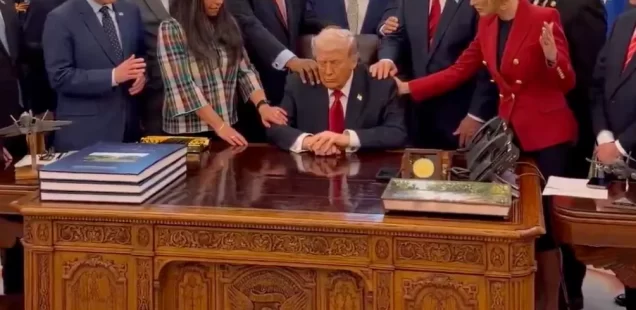
The Sun, Nigeria’s leading daily (and I tip my cap to its journalists for this), posted a video on “X” on 6 March, a week into the war, showing what looks like a laying on of hands as Trump sits solemnly at the Resolute Desk, a semi-circle of parsons behind him. “President Donald Trump hosts pastors from across the U.S. in the Oval Office,” The Sun’s caption reads, “for a prayer vigil seeking divine guidance in the escalating Iran conflict.”
Look at this footage, about a minute and a half, and consider what you see and hear, I urge readers. As the Trumpster sits with his hands folded upon themselves, eyes closed, and his head bowed, one of the churchmen to his right intones incantatorily:
I pray for your grace and protection over him.
I pray for your protection of our troops.
And all of our men and women serving in our armed forces.
And, Father, we pray you continue to give our president the strength he needs to lead our great nation.
And so on.
Along the continuum running from political performance to anxiety and fear, video of this sort suggests Trump is now closer to the latter. The search for purpose when there is no purpose. The claim to righteousness as the first body bags arrive on C–17s at Dover Air Force Base.
There is in the background the case of Mike Huckabee, who Trump had no problem naming his ambassador to Israel. As was widely reported a couple of weeks ago, Huckabee, a limitlessly deluded Christian Zionist, told Tucker Carlson, the prominent independent webcaster, that Israel has a “biblical right” to lands from the Nile to the Euphrates—territory the Zionists refer to as Eretz Israel, “Greater Israel.”
And in the foreground there is Pete Hegseth, Trump’s defense secretary, who often appears lost in nostalgic fantasies of past military glory. In American Crusade (Center Street, 2020), written while he was still a Fox News presenter, Hegseth referenced the 12th century adventures of European armies and wrote, “Today’s American Crusaders will need to muster the same courage against the Islamists.”
Reflecting the hopelessly muddled minds and beliefs of these kinds of people, Hegseth has also taken lately to holding hyper–Christian prayer sessions at the Pentagon with decidedly Old Testament themes of endless revenge. There is no making any sense of this. Parenthetically, I wonder what Trump’s “secretary of war”—and for that matter Huckabee—will make of Moshe Gafni and Yaakov Asher, two members of the Israeli Knesset, who have just submitted a draft bill that, if passed, will make it a criminal offense to speak publicly of Jesus or otherwise promote Christianity in all varieties of media.
■
What am I, shocked by this drift into the strange precincts of Christian messianism, or not surprised at all? Both, I think. It is a dangerous madness that the Trump regime and much of its military command seem to dispense with all reason as they wage what they offer Americans as a religious war. This amounts to straight-out irrationality. We witness the determined de-modernization of the republic.
On the other hand there is precedent. For this we need go back no further than 11 September 2001 and Bush II regime’s invasion of Iraq two years later.
“The great purpose of our great land is to rid this world of evil and terror,” the younger Bush had said after the events of 11 September. “The evil ones have roused a mighty nation, a mighty land.”
The evil ones. Are you listening carefully?
Later, as Bush sought the support of the Europeans amid preparations for the Iraq invasion, he telephoned Jacques Chirac—twice by reliable French accounts—and in his (failed) attempt to recruit the French president made reference to Gog and Magog, the satanic figures found in Revelations, who appear when the “end time” is near and the great war between good and evil was at last to be fought. Accounts of these exchanges—Chirac privately scoffed in amazement—were published in France in 2009; they were unpublished in America until William Pfaff, my late colleague and friend, brought out The Irony of Manifest Destiny (Walker, 2010). It was Bill’s last book.
What do we hear when senior members of America’s political elite take to casting geopolitical events as biblical prophecies? In the immediate case, there are 30,000 to 50,000 Christian Zionists in the United States. As earlier mentioned, they must remain loyal to Trump and the M.A.G.A. cause, which by many accounts is suffering a lapse of conviction. These people must be assured that Trump buys the story they tell themselves, one that enables them to embrace a war, his war, which would otherwise make no sense to them: Yes, “God’s divine mission.”
More profoundly, and this is the lesson I urge we draw, this is the sound of an imperium that is deeply uncertain of itself. This is what I hear—a nation that sought “the end of history” long before Francis Fukuyama wrote his idiotic book but has never been able to find it. Confronted with 21st century realities—notably but not only the emergence of the non–West as a pole of power—the Trump regime, and Bush II before it, are no more comprehending or confident of themselves than Jonathan Edwards as he sought to counter the arriving Age of Reason three centuries ago.
Power in combination with uncertainty, desperation, an assiduously submerged fear: These are not promising in combination. What Bush II handed Americans with his wars in Iraq and Afghanistan is a good guide to where this leads.
In one of his ever-changing, transparently hollow displays of grit, the other day Trump sent out another account of his policy toward Iran. “There will be no deal with Iran except UNCONDITIONAL SURRENDER,” he wrote on his social media site, “and after selection of a great and acceptable leader.” These are the words of a regime whose material power is beyond dispute, but precisely one that is in some measure uncertain, desperate, and fearful of what will come of what it has begun.
An earlier version of this essay appeared, in German, in Global Bridge.
Independent journalism and commentary requires investment to sustain itself. If you appreciate what you read at The Floutist, please consider a contribution. You can become a paid subscriber by clicking the red tab at the bottom of this post. You can “buy The Floutist a coffee.” Or you can support our work via Patreon. Follow us: @thefloutist. And please share this post. Thank you.