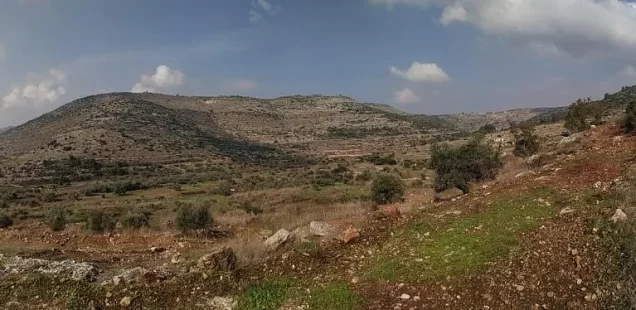
“In the West Bank, it’s a showdown now.”
“What we are talking about here is an Israeli establishment that is aiming at extermination of the Palestinian people. In every possible way. Not only in Gaza but in the West Bank.”
— Mustafa Barghouti, interview, @MEEunapologetic
7 JULY—As Americans celebrated the 250th birthday of their country, Palestinians in the Occupied West Bank are rapidly losing what little remains of theirs. By long-established policy, “the Jewish state” uses the opportunity and cover of war—the war on Iran, the Gaza-style slaughter in Lebanon, the continued attacks in Syria—to advance its perverse ambitions for a “Greater Israel.” It is doing so in the West Bank with remarkable haste and brutal efficiency.
These historic events—the celebration of empire on one continent and the annihilation of an indigenous people on another—are deeply entwined. Let us not miss the connection.
The Zionist project in Israel is the same operation of occupation, aggression, dispossession, ethnic cleansing, and genocide that goes back to the European colonial era and the founding of the United States. Tens of millions of indigenous peoples in the Americas, north and south, in Australia, New Zealand, Africa, and West Asia have been slaughtered on the alter of Western empire. Zionism in Israel began and continues as a project of Western colonialism and hegemonic power. This is the connection it is our responsibility to make and never lose sight of. I write now in the cause of this responsibility.
The first European arrivals to North American shores referred to the land they colonized as a “New Zion” and a “New Jerusalem.” The land called “America” after an Italian cartographer—rich in resources, populated by an estimated 50 million to 100 million linguistically and culturally diverse inhabitants—was conceived by Puritans as a “Promised land,” God’s gift to a chosen people. And with the Puritans, Christian Zionism took root.
The project of realizing the Promised Land was vigorously taken up by the Founding Fathers, several of whom—notably Washington, Jefferson, and Franklin—likewise viewed the nation as providentially ordained and blessed. Franklin described the colonies as “God’s New Israel.”
This noxious, racist ideology fueled the subsequent expansion, ethnic cleansing, and genocide as it spread westward across the continent. When America had finally settled within its acquired borders, the exceptional country and its exceptional people, quite predictably discontented, took up the project of creating a continental and ultimately global empire.
And here we are.
This long project of empire—American empire—bears directly upon the fate of Palestine. Palestinians understand quite well that the main obstacle to their freedom and an end to their oppression is the United States—the “head of the snake.” It behooves us, I urge, to achieve and hold to this same understanding.
“There’s a showdown happening in Palestine”—to borrow a much-loved American term that arose during the westward expansion—a face-off between civilization and barbarism: The empire on one side and Palestinians—farmers, Bedouins and shepherds, Arab Christians, and Muslims—on the other. Poignantly but somehow fittingly, this now happens in an historic cradle of civilization. The outcome will determine whether humanity remains civilized or continues its descent into savagery. The fate of Palestine and Palestinians will determine ours—all of us, no matter where we live. I read this moment as a decisive confrontation. Will ideological and technological barbarity triumph? Or will human dignity and basic decency?
If Zionism wins we face a future of totalized surveillance and control, totalized violence being the terror state’s response to all resistance. The genocide conducted against the Palestinians of Gaza will serve as the template. Elevated to a protocol, the obliteration of Gaza will be replicated against all threats to power—every uprising, every rebellion, every troublesome people or population. Nearly all facets of life, human and non-human, not already dominated will be by a cabal of financiers, arms merchants, tech–and-surveillance billionaires, and corporate oligarchs—the untouchable Epstein class.
We—we Americans, we citizens of the world—are in this fight, on one side or the other, knowingly or not. Could the shocking influence of the Zionists in so many aspects of American life make this any clearer. Most of our media go to the utmost lengths to obscure this fight from us. Our responsibilities begin with seeing it despite what is effectively a blackout—and the immoral indifference of so many among us.
What follows is a report from the active front line in this struggle for Palestinian liberation and human dignity. It describes the situation on the ground in the West Bank village of Beitillu, where, as the violence escalates daily, Palestinian farmers refuse to leave their land.
This report replies substantially on audio and written texts sent to me over the course of two weeks by a contact who lives in Beitillu. To ensure her safety, I use as a pseudonym the common Arabic name Aisha, which translates as “to be alive” and also “prosperous.” Aisha’s English is exceptionally good. I have made few edits and only for clarification.
Here is a Palestinian voice reporting directly on what is now unfolding in every village across the entirety of the West Bank. This is what aggression and resistance look like: unarmed farmers against all the weapons—military, political, diplomatic—of empire.
—C.M.
Beitillu.
A gang of Jewish thugs in their early twenties, members of Hilltop Youth—über Zionist, rabidly violent—pitched a blue tent on the top of a small mountain known to locals as Jabal Baten al–Hayya. With that act they established an outpost on land belonging to the nearby Palestinian village of Beitillu. It was the second Tuesday in June and the second outpost erected on Beitillu land.
Violence followed.
Three days later, on Friday, 12 June, they attacked numerous farmers working their land. I received a series of texts from Aisha on 16 June describing the attack. I publish these messages, and all of her subsequent reporting, as block quotations interspersed with my explanatory comments.
Settlers have attacked us with the protection of the Israeli solders. The situation is really bad. They have put a settlement outpost on our land. Now they are attacking the farmers—and we are the farmers of the land. They have put the outpost on top of a mountain and that mountain is between four villages: Beitillu, Deir Ammar, Jamala, and Deir Abu Mash’al.
People from the village are in the hospital. I don’t know how to explain the situation. They are damaging the land now, the crops, everything. What happened on Friday was really a catastrophe.
They, the occupation forces, the I.O.F., arrived after the people were injured, after the attack, and detained us. They detained everyone and started doing investigations, interrogating the people—and we were attacked on our own land.
The attack was brutal. People were beaten with rocks and sticks. There were multiple injuries, several people required hospitalization. When the I.O.F. showed up, they detained all of the villagers and held them for questioning. As this happened, the settlers damaged cars that had been parked near the agricultural fields, smashing windows, slashing tires, leaving the cars inoperable.
While we were being detained we could hear people on the other side (of Jabal Baten al–Hayya), on the lands of the neighboring village of Jamala, shouting because they could see the settlers damaging our cars. We could also hear the sound of our vehicles being smashed.
I shouted and told the soldiers that the settlers were damaging our cars. Everyone could hear what was happening. The soldiers did nothing to stop it. Instead, after I spoke up, they separated me from the rest of the detainees and took me aside as a punishment for speaking.
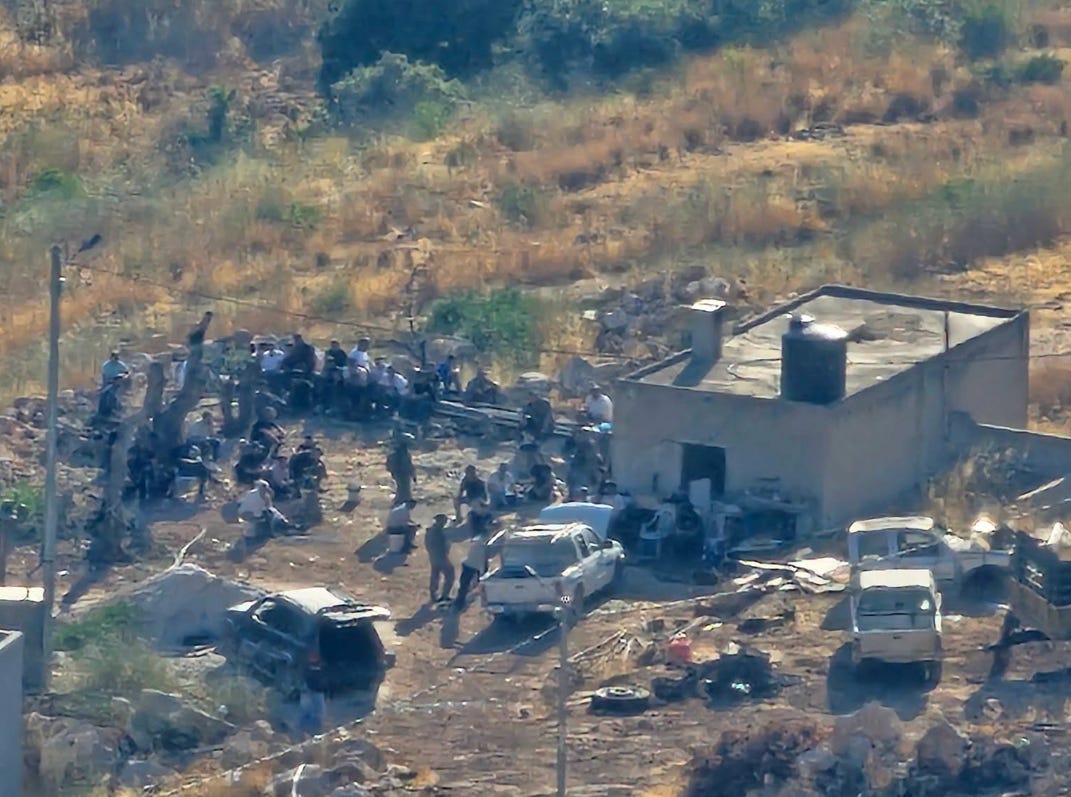
The photo above shows villagers being held and questioned by the I.O.F.
Meanwhile, settlers were damaging their cars:
View the video on the original article.
When the villagers were finally released, and with their cars too damaged to drive, they were forced to carry those who’d been injured across the valley, over the mountain, and back to the village. From the village, people were driven to the metal barrier blocking the main road to Beitillu. Ambulances waited on the other side of the barricade to transport the injured to a hospital.
Like most Palestinian villages, access to Beitillu has been blocked since 28 February, when Israel attacked Iran. (See photos below.) On that day, more than 800 checkpoints and barriers were closed across the West Bank. Main access roads to Palestinian communities remain barricaded, making life almost impossible on every level. Aisha drives more than two hours each day on primitive dirt roads to get to work in Ramallah—a forty-minute round trip when the main road is open. The road she’s forced to take passes near the new outposts, putting her at constant risk of attack.
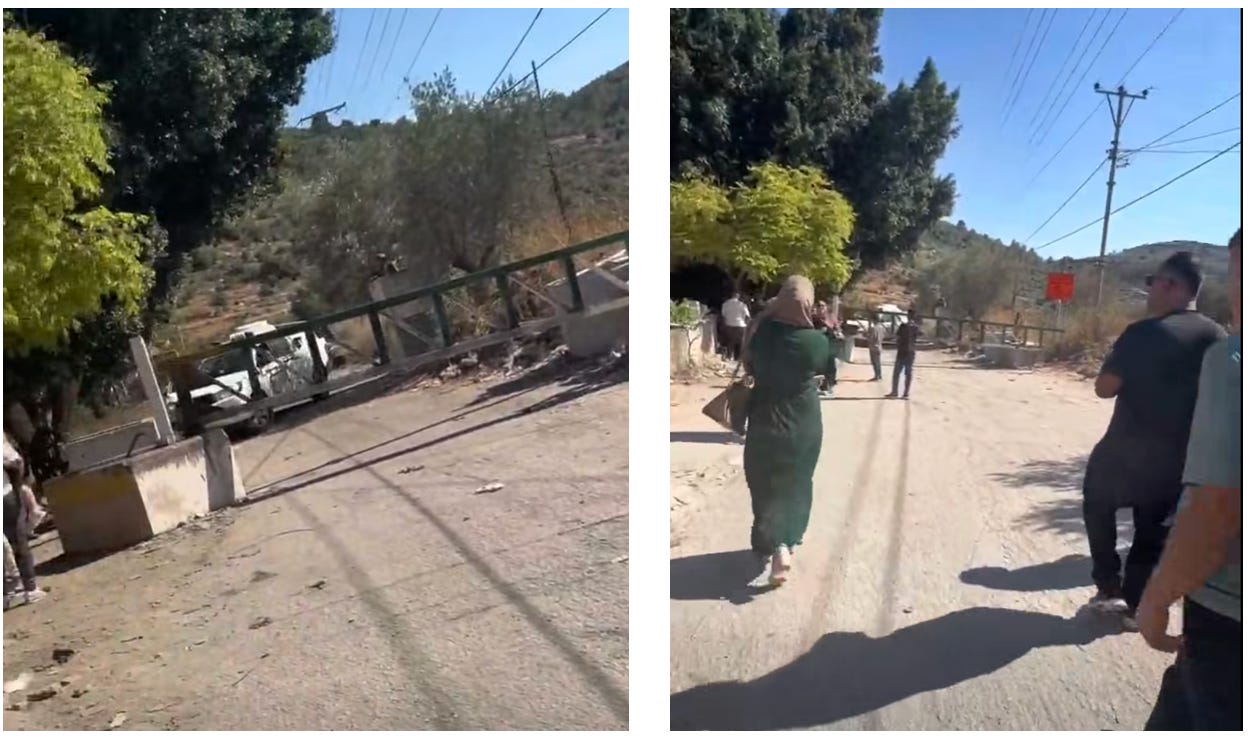
Since the beginning of the Iran war, the occupation has kept the gate closed. People have no choice but to crawl underneath it to reach their jobs, schools, hospitals, and homes.
Children have been forced to pass under the gate on their way to school. Kidney patients and even the deceased have been carried underneath it because there has been no other way through. People cross on foot, often while facing tear gas and other attacks.
This is the only direct access for the villages of Beitillu, Deir Ammar, Jamala, and Deir Ammar Refugee Camp. The alternative route is a long, unpaved road that passes beneath the newly established settlement outpost, making everyday movement significantly longer and more difficult.
Closing this gate is not simply a restriction on movement. It is part of a broader policy of tightening control over Palestinian communities, isolating villages from one another, disrupting daily life, and making it increasingly difficult for people to remain on their land.
(Four-month-old Ahmad Marouf Zeid from the village of Deir Ammar died two days ago, 5 July, when occupation forces refused to allow his parents to pass their baby over the metal barricade to paramedics waiting on the other side—the very same gate in the photos above. Al Jazeera published a video report of the incident yesterday. I decided to share this latest tragic news so that you know how dire the situation is. This is what genocide looks like in the West Bank—a different and slower version of the one that continues in Gaza.)
■
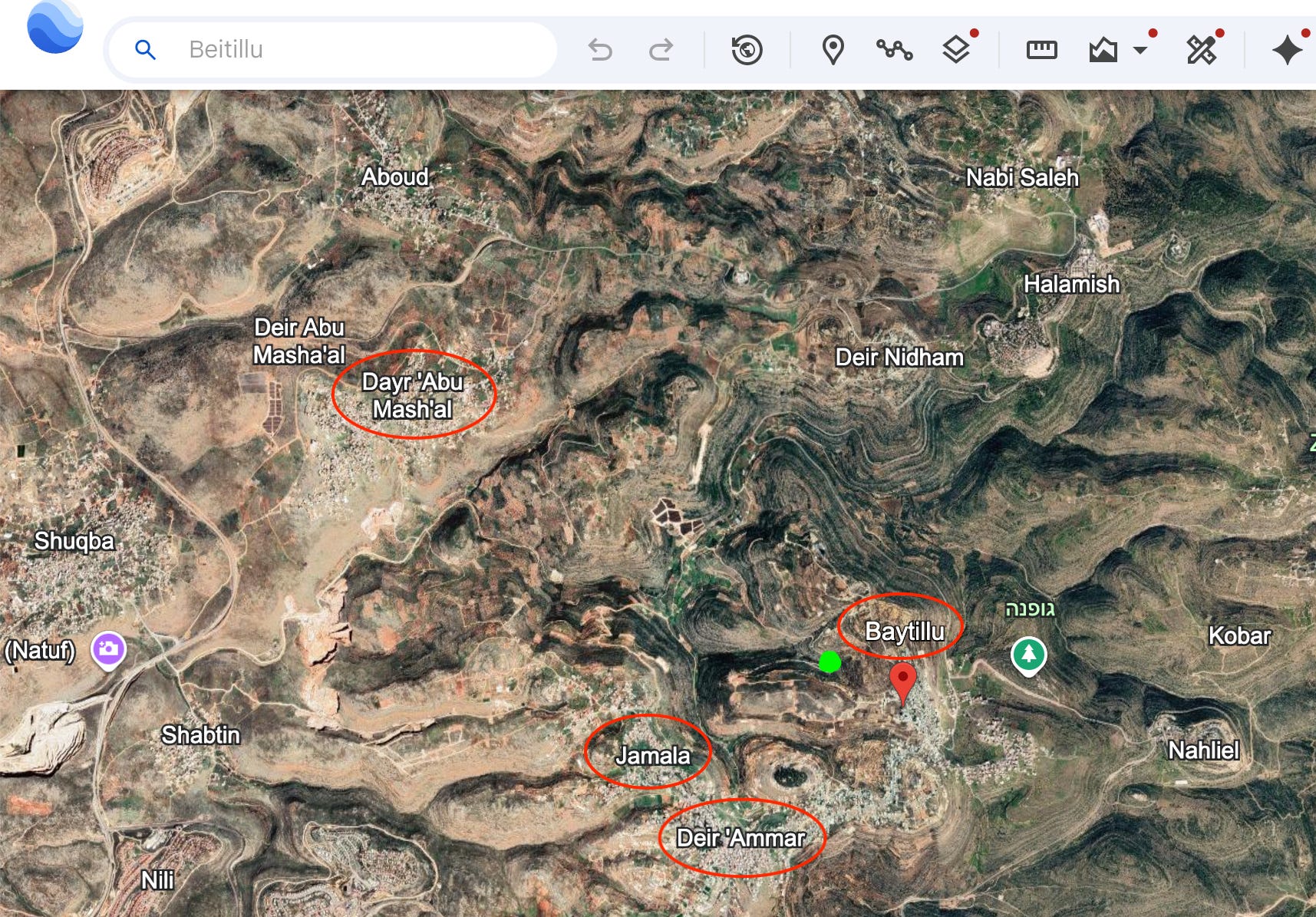
Beitillu is 24 kilometers north and west of the city of Ramallah. All four villages described in this report are located within the governorate of Ramallah. Each village is located with a colored dot: Beitillu (Red), Deir Ammar (yellow), Jamala (green), and Deir Abu Mash’al (blue).
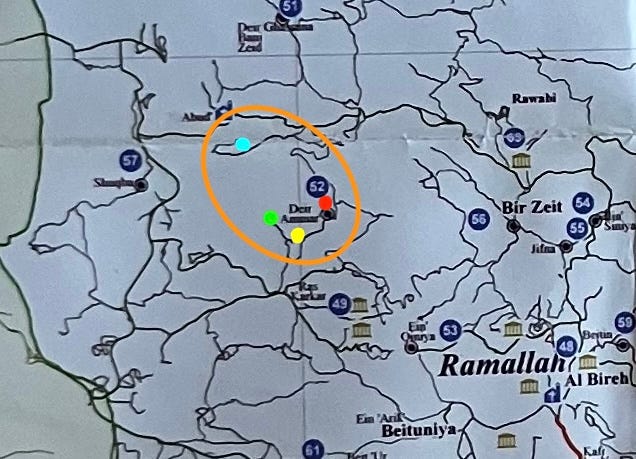
The Google Earth map below shows the four villages, each circled in red. The green dot at the left of Beitillu is the small mountain of Jabal Baten al–Hayya.
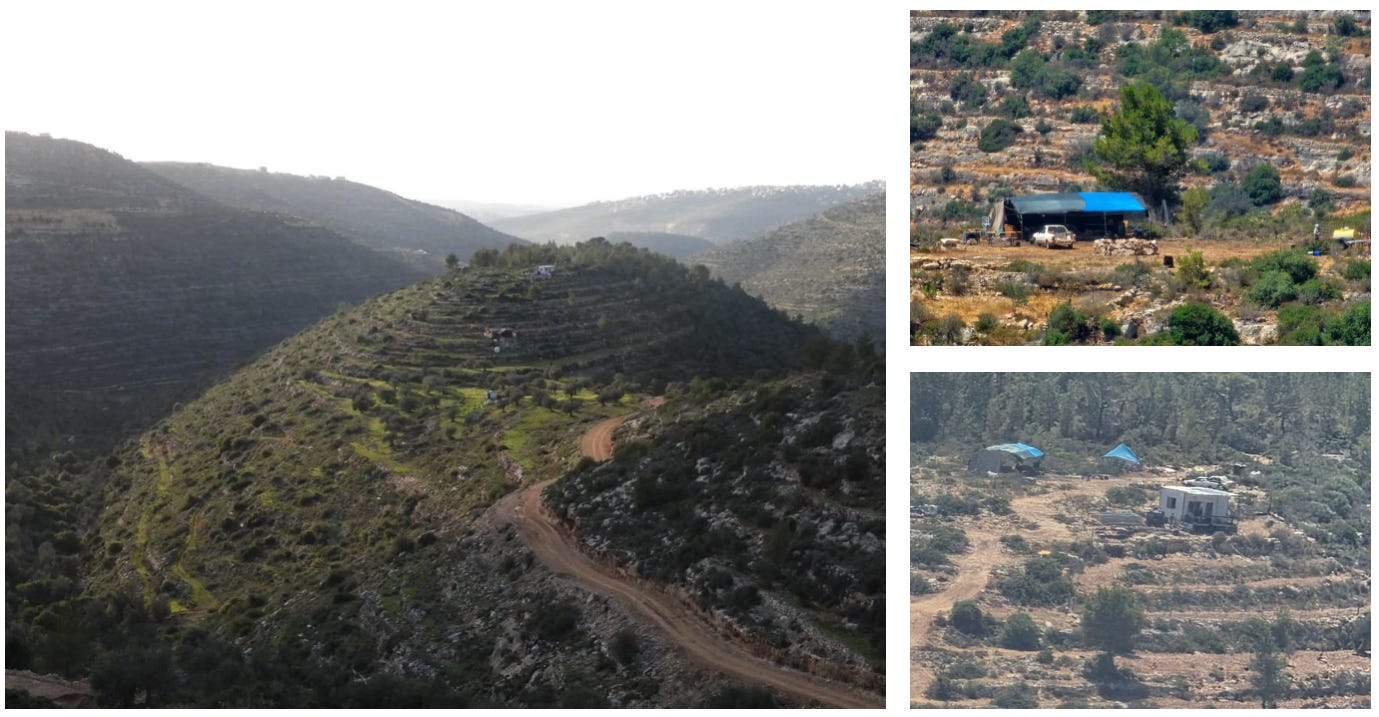
In the following photo, you see Jabal Baten al–Hayya (left) as it was before the outpost was established. The photo at the bottom right was taken on the day the tent was erected. The top right shows the outpost as it is now. To the right of the tent is a goat pen not visible in the photo. The outpost was erected next to a small Palestinian-owned structure. Cascading down the mountain side are ancient agricultural terraces built and maintained over centuries and millennia.
■
Aisha described the situation in more detail, in the following texts:
The settlers first erected a tent as an outpost around two weeks ago—in the last week of May. Then, on 9 June they set up another tent on Jabal Baten al-Hayya. That tent was accompanied by a herd of goats. As usually happens in these cases, once settlers establish a tent/outpost, the Israeli army and police arrive to protect them.
The wider area affected by the outpost includes agricultural lands around the mountain and the surrounding valleys. The most directly affected agricultural area is Wadi al-Zarqa, which is a highly fertile farming area covering approximately 8,000 dunams (2,000 acres). It includes cultivated lands, vegetable fields, and water springs. In Beitillu alone there are 101 springs, and these water sources are also under threat.
This land is not simply a source of livelihood. For us, it is a struggle for survival, dignity, and existence. The land is our honour, our identity, and our place in this world. We are the people of this land, and no force on earth can sever a farmer from it.
What is happening is not only an attack on crops or property. It is an attack on our presence itself. That is exactly why farmers continue to go to their land every day. They leave before dawn, they work the soil, they harvest, and they remain there despite the attacks, because abandoning the land is not an option.
The army prevents other villagers from coming to support them, protects the settlers, and uses tear gas and sound grenades against people trying to reach the area. But the farmers still go. They go every single day, because this is how we have always lived with our land, and because surrendering it is not something we accept.
■
In a report published 16 June, Haaretz described settler violence in the West Bank as “out of control.” This is “hasbara lite” from the Israeli daily that too frequently bemoans the loss of Israel’s mythic liberal democracy. In reality, and as the report itself describes, the government intentionally created conditions to ignite uncontrolled violence. After 7 October, the I.O.F. distributed roughly 7,000 Israeli long guns—military–grade weapons, fully automatic—to Jews in the West Bank.
While at the same time, 8,000 settlers were inducted into “territorial defense units.” These settler militias, in coordination with the I.O.F., launched a reign of terror across the West Bank. The genocidal government in Tel Aviv erased any meaningful distinction between settlers and soldiers, empowering them to coordinate efforts to rid the land of Palestinians.
At publication, only five or six settlers currently occupy the tents erected on Beitillu land. But they work with great efficiency and their numbers will soon grow. They post frequent calls to action on social media and are joined every day by large groups of settlers—some twenty or thirty—who arrive on all-terrain vehicles to participate in the attacks—ATVs distributed to settlers by the Israeli government specifically for the purpose.
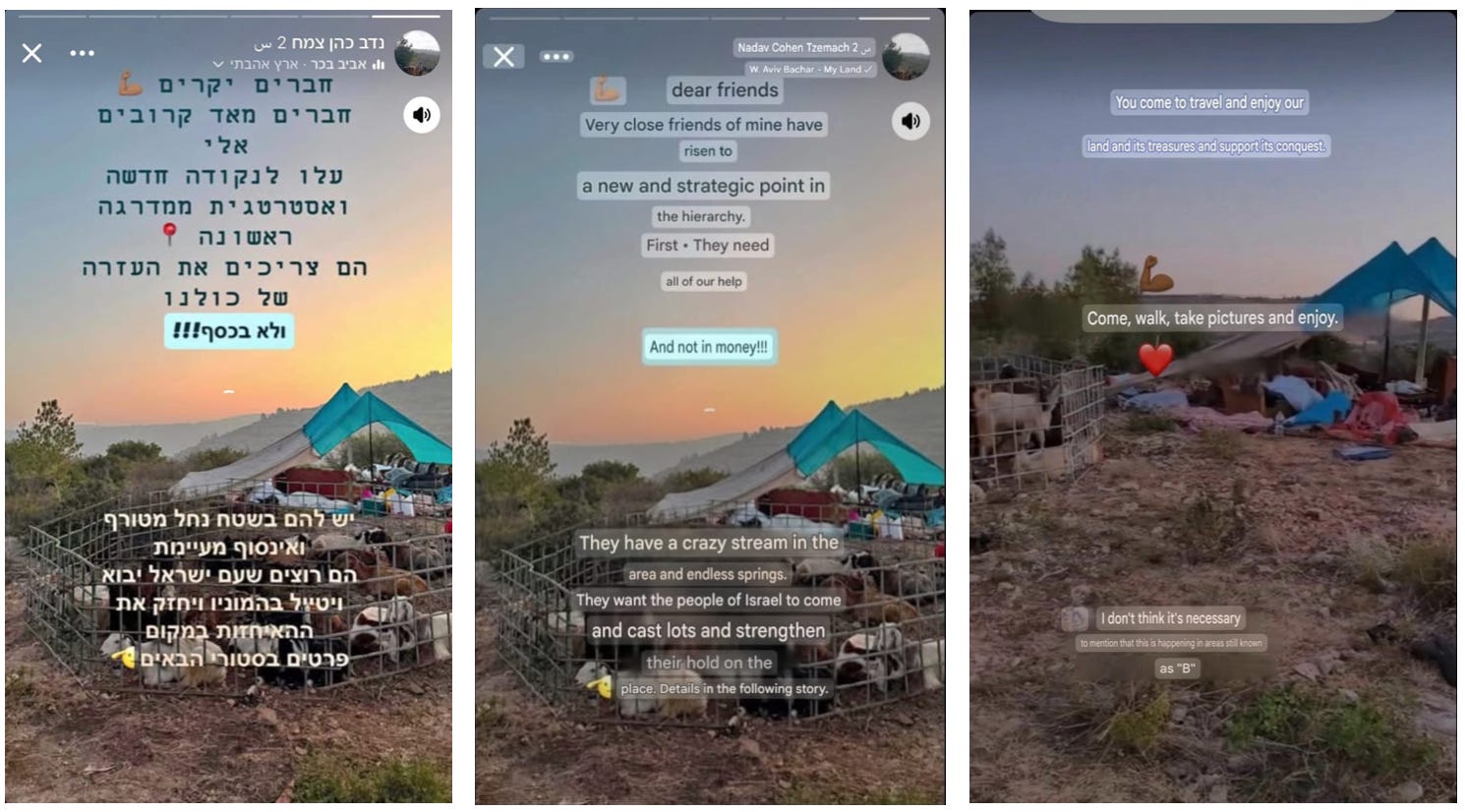
The second and third posts (above) are in English. The middle one reads,
dear friends
Very close friends of mine have risen to
a new and strategic point in the hierarchy.
First – They need
all of our help
And not in money!!!
They have a crazy stream in the area [Wadi al-Zarqa] and endless springs.
They want the people of Israel to come and cast lots and strengthen their hold on the place.
Known as the breadbasket of Ramallah, Wadi al–Zarqa is noted for its fertile land and abundant springs. These members of Hilltop Youth are now stealing water and have put out a video (below) announcing plans for a water park. In it they brag about stealing a spring, announce their intention to create the park, mock Palestinians, and tell viewers (other settlers) they can access the area through Wadi al–Zarqa. The swimming pool, spring, and surrounding land shown in the video belong to a Palestinian family.
View the video on the original article.
■
Every day there are new attacks as settlers continue their relentless efforts to drive the people from their villages and land. Another violent attack on Beitillu farmers occurred on 3 July and was reported by Wattan News Service located in Ramalla. Several members of the same family were injured; one brother sustained a concussion, the other a broken hand.
Every day settlers destroy crops in the fields, steal water and irrigation pumps, cut irrigation lines, and damage or completely destroy olive, fruit, and nut trees. In a common maneuver all over the West Bank, they release goats (or sheep) into cultivated areas and greenhouses. The animals eat and destroy everything.
Settlers target all of our crops. They’ve damaged vegetables in front of us by beating and trampling them. In my family’s case, after opening the farm gate and allowing wild boars to enter, the animals caused major destruction to crops such as cucumbers, peppers, and eggplants. Settlers recently stole and destroyed tomato crops from other farmers. An apiary was also destroyed.
They recently tried to force their herd of goats into our greenhouse. When we objected, the settlers responded violently and attacked us.
People continue to reach their land every day despite the danger. Farmers go before dawn and use rough mountain paths and indirect routes because the main roads have been blocked by the army and police. The army prevents other villagers from gathering to support the farmers and often uses force to disperse people, including tear gas and sound grenades.
But the farmers still go, because leaving the land is not an option. They continue planting, harvesting, and working the land despite the attacks and despite the restrictions. The land is their life, and remaining on it is itself a form of resistance and steadfastness.
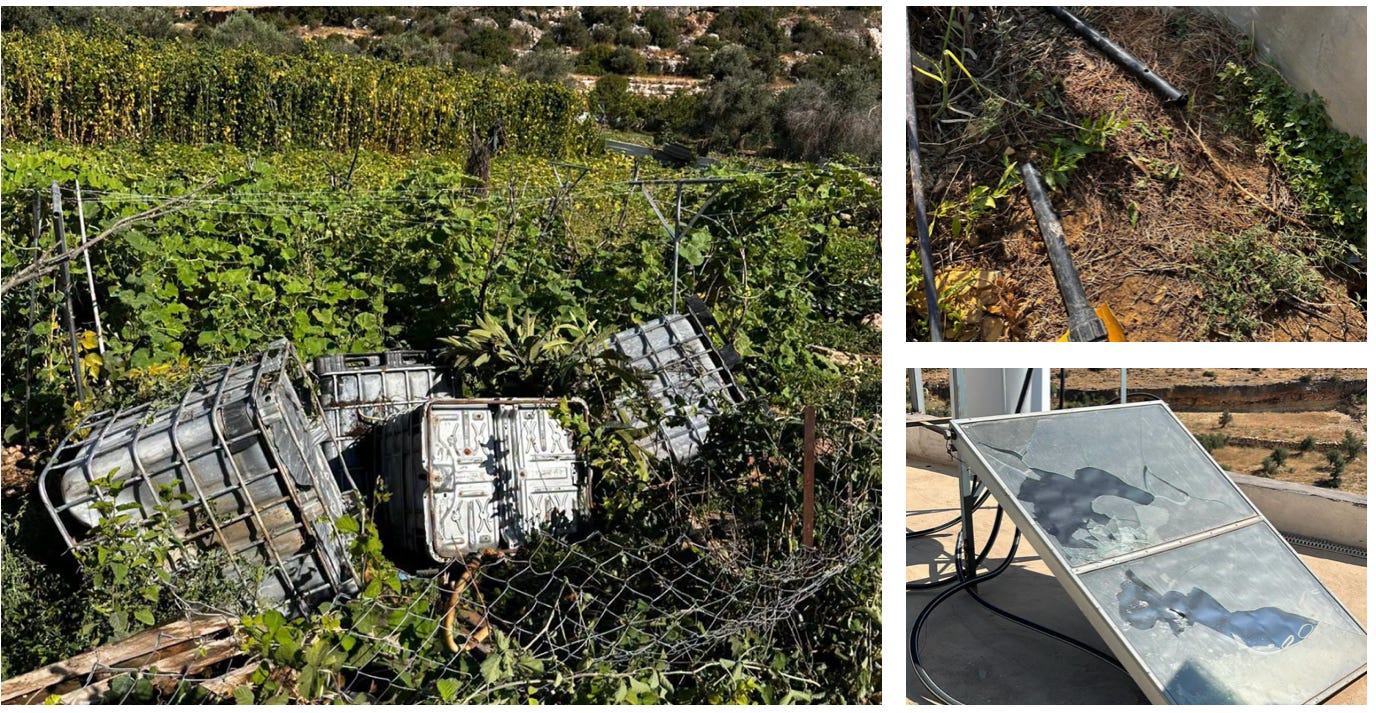
The photos below show water tanks (left), irrigation pipes (top right), and a solar panel (one of many) destroyed in the farmland belonging to the village of Jamala.
■
In the video below, a Palestinian family is chased from their land by settlers. It documents the unhinged violence and murderous intent of these Jewish mobs. There is nothing unusual about what you witness in this video. It is an absolutely routine attack. This is the true face of Zionism and the Zionist state. And this criminal violence is supported by a vast majority of Israeli Jews—and, it must be said, every Zionist in the United States, Jew or Christian.
View the video on the original article.
The following texts describe the violence in more detail:
The settlers are armed. They use direct physical violence against farmers and villagers, including stones, sticks and blunt objects, pepper spray.
As of now, in the incidents I am describing here, settlers were armed but they did not shoot anyone. However, they use extreme physical violence and attack people in ways that caused serious injuries.
They have also been accompanied and protected by soldiers who use force against Palestinians, including tear gas and sound grenades to prevent people from reaching or defending their land and from protecting one another.
One of the most serious cases was in the nearby village of Deir Abu Mash’al, where five people were attacked by settlers, trapped inside a room, and beaten very severely with sticks and other blunt objects. One of them remains in a coma and has not regained consciousness for more than a week.
In another incident, a woman and her teenage daughter, around 15 years old, were alone in the land picking grape leaves when settlers attacked them with stones and beat them badly. Their ribs were broken in the assault.
The man in the photo below (left) is Musa Rabee. This is the villager from Deir Abu Mash’al who was beaten on the head and left in a coma. At right is another villager from Deir Abu Mash’al who was hospitalized after being attacked. I have not been able to get information about Musa Rabee’s current condition. These images were widely posted on social media and I was assured that it was safe to publish them.
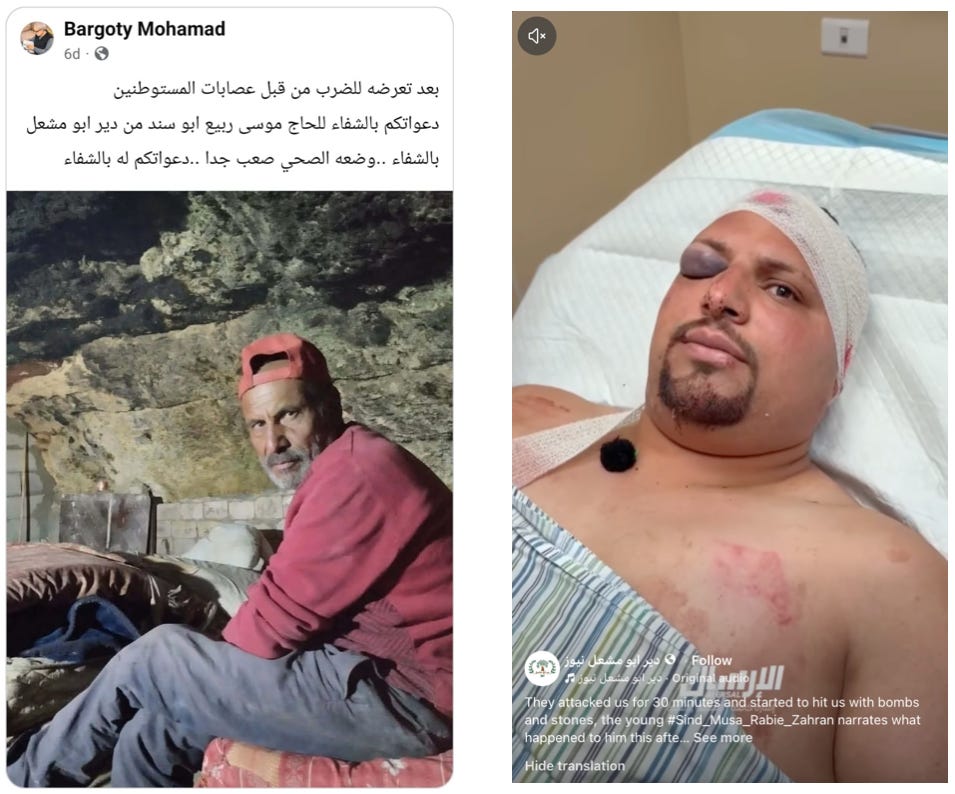
The following quotation is from a report about the incident posted on FaceBook. It was not written by Aisha. I chose not to divulge the author’s name to protect his identity. I share this because of the spirit of respect and resistance it conveys. Here, too, is an important Palestinian voice:
Brother Musa “Abu Sand” is not just any ordinary citizen; he is a veteran of the First Palestinian Intifada, one of the men who dedicated years of struggle and resistance to defending the homeland . . .
. . . We pray for the speedy recovery of our brother and all the injured, and we salute the people of Dair Abu Mash’al who prove day after day that the land watered by the sweat of fathers and sacrifices of fighters will remain resistant to confiscation and uprooting, and that our people will continue to defend it no matter how great the challenges and sacrifices.
These “fighters” are unarmed men and women who insist upon their dignity and the right to remain on their land. They confront the Zionist state not with weapons but with the fact of their centuries– and millennia–long presence in the land of Palestine and their refusal to leave. For this they are hated. For this they are targeted for genocide.
■
The I.O.F. routinely coordinates attacks with settlers while preventing Palestinians from supporting each other. By isolating villages, and farmers working in their fields, Palestinians are left defenseless. Here is Aisha again,
On 12 June, when settlers attacked farmers from my village [Beitillu] people from the surrounding area rushed to help. Had they not come, the attack could have continued in the same way it did in Deir Abu Mash’al and other nearby areas, where settlers carried out severe assaults against farmers. The intervention of local people was what prevented the attack from becoming even worse.
The Israeli army and police are not neutral. They come to protect the settlers, and in practice they facilitate the attacks and prevent Palestinians from defending themselves or reaching their land.
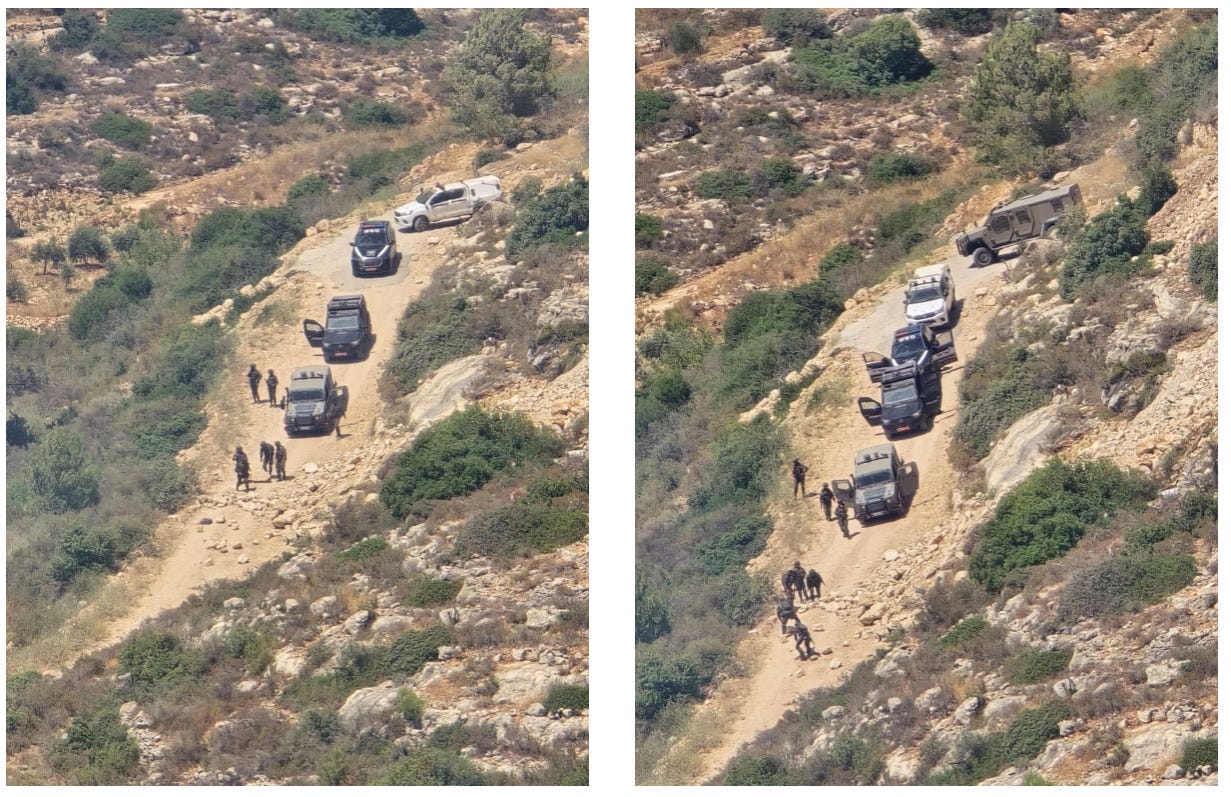
The photos below show occupation forces building a stone barricade across one of the access roads to the farmland. In future attacks, people from Beitillu will not be able to drive to help the farmers as they did on 12 June.
■
On 25 June, in one of the final texts of our exchange, Aisha reported on the construction of a new road which will make most of Beitillu’s farmland inaccessible.
The village [Beitillu] is bordered to the east by the village of Kobar [see Google Earth map above], and settlers are currently constructing a new settler road on the lands of Beitillu in the direction of Kobar. In practical terms, this means the seizure of what remains of the village’s northeastern side and its complete isolation. Considering that the western side of the village, where the mountain is located, is already under the control of the settlement outpost, what is happening today is not simply the construction of another road, but the continuation of a much broader process of swallowing up the village’s lands.
In effect, we are talking about control over the east, northeast, north, and west of the village, meaning that the northeastern and northwestern parts of the village have effectively had their lands devoured through the establishment of the outpost and the construction of this road. As a result, the village’s agricultural lands have been besieged and taken away, while their Palestinian owners are denied access to them.
This was made explicitly clear today when one of the farmers attempted to reach his land near the road currently being built. He was expelled from the area by the army and police, who told him in clear terms that he was strictly forbidden from being there. When he asked how he could be prevented from reaching his own land, their response was: “How dare you come to this area? You are absolutely forbidden from being here. You have no land here.”
This makes it clear that what is taking place is not merely a temporary restriction or closure, but a confiscation of the land and the forcible denial of Palestinian landowners’ access to it.
■
The mechanisms of ethnic cleansing were put into place over many decades of duplicitous peace negotiations in a strategy—intentional on Israel’s side if not also the Americans’—that used the diplomatic process to betray Palestinians and enable Israel to expand settlements throughout the West Bank. These various accords and protocols weakened the P.L.O. and fragmented what remained of Palestine.
This is not only about settler violence in the narrow sense. It is also about a political and economic structure that has left Palestinian farmers completely exposed. There are no real policies to protect them, no agricultural protection, and no serious support that allows them to remain on their land with dignity.
Farmers work the land, but when they try to sell their produce they can barely recover their costs, let alone make a living. The Palestinian market is flooded with Israeli goods and agricultural products, while Palestinian farmers are left to compete without protection and without any meaningful economic policy that defends local production.
The Palestinian Authority is part of this reality. Through the economic arrangements imposed under the Paris Protocol, the Palestinian economy was tied to the Israeli economy in a way that deepened dependency and weakened the ability of Palestinian farmers to survive on their own land.
What is happening now builds directly on that reality. The goal is clear: to swallow the land around the settlements, isolate Palestinian villages, and turn them into besieged cantons while pushing people either into urban areas or out of the country altogether. This is not a side effect of what is happening. It is a transfer project. It is a project of forced displacement, carried out step by step through outposts, road closures, attacks on farmers, destruction of crops, theft of water, and making life on the land impossible.
And yes, some people do leave—whether to urban areas or outside the country—because they are exhausted, because they fear for their children, because they have lost everything, or because they still believe they may be able to leave and return later. That does not mean they are weak or that they have surrendered. People are trying to survive. But the danger is exactly that every family pushed out and every farmer prevented from reaching the land creates more space for settlement expansion and pushes this transfer project forward.
At the same time, there are still people—especially farmers and shepherds, the salt of this land—who refuse to leave. They are the ones who still wake before dawn, go down to the fields, plant, harvest, and risk being beaten or attacked just to remain on their land. And that is precisely why they are being targeted so aggressively: because as long as the farmer remains on the land, the land remains Palestinian.
Let us keep on bearing witness together. Palestinians I know tell me how much this means to them. But, however important, bearing witness is the first and least of what you, I, we are called up on to do. This struggle is our struggle. This fight is our fight, too. To paraphrase Craig Murray from the early days of the Gaza genocide: Decide what it is you can do and do it.
Published previously at West Bank Alerts and Winter Wheat.
Everything I write is freely available. If you appreciate what you read, please consider supporting my work. You can become a paid subscriber by clicking on the button below. You can “buy me a coffee.” You can send a one-time, monthly, or yearly donation via PayPal. Or you can support me on Patreon. You can also share this commentary. Thank you.